Is Nantucket's Year-Round Population Still Growing? School Enrollment Is Declining, But Other Data Is Mixed. The Uncertainty Is The Story
JohnCarl McGrady •
Has Nantucket’s year-round population stopped growing? Maybe.
Private and public datasets obtained by the Current show mixed evidence, and given the high level of uncertainty that has shrouded recent local population estimates, the real answer may never be known for certain. But the data, analyzed here for the first time, does raise questions about an assumption that many Nantucket residents have taken for granted in recent years.
For the first time in decades, it is possible - though far from certain - that the number of people living on Nantucket in the winter may no longer be increasing. Whether or not Nantucket’s population is still growing, the existence of the uncertainty is notable in itself: as recently as six years ago, Nantucket’s year-round population growth was undeniable. Now, the story is much less clear.
Public school enrollment on the island has leveled off since 2020, and now appears to be declining. Volatile metrics like water and energy consumption, complicated by droughts, heatwaves, and last year’s anomalously cold winter, point in opposite directions after previously indicating clear growth. Solid waste numbers provided by the Department of Public Works do not suggest any growth in Nantucket’s year-round population since 2020, although those numbers come with their own caveats. At public meetings and in private conversations over the last few months, several town leaders have begun to suggest that, when the next decennial census is conducted in 2030, it may show Nantucket’s population down for the first time since 1940, when the island had fewer than 3,500 residents.
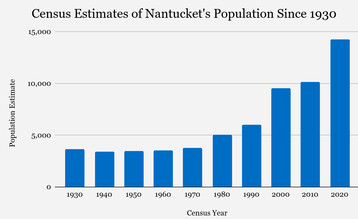
None of this data is conclusive. The datasets analyzed here do not measure Nantucket’s population directly, and should not be considered definitive metrics of what may be happening on the island. There are alternate explanations for every trendline, and even as far as they can be considered indicative of population movement, they do not always point in the same direction. The takeaway from this analysis is not that Nantucket's population isn't growing, but rather that growth is no longer a certainty.
Attempts to directly measure Nantucket’s population are also fraught with errors: it is widely accepted that the U.S. Census underestimates the island’s population, undercounting immigrants and non-native English speakers, and the last attempt to produce an independent estimate of Nantucket’s population was conducted in 2019. That analysis, which used data from a town street list and a private data analytics firm, may have been accurate at the time, but has not been updated since.

The next decennial census may be even more inaccurate than usual. The Nantucket Planning and Economic Development Commission, a local long-range planning body, recently voted to pen a letter to the Census Bureau asking the agency to scrap proposed changes to the census that the Commission worries would further compromise the data for Nantucket.
Under President Donald Trump, the Census Bureau has proposed excluding many immigrants from official census counts, only tallying citizens and green card holders. Those changes, which the Bureau says are needed to ensure that only “true inhabitants” of the United States are counted, could lead to significant underestimates of the actual populations of many states, including Massachusetts. The consequences could be particularly stark for Nantucket, which has a large immigrant population, prompting the Nantucket Planning and Economic Development Commission’s letter.
Rather than determining that Nantucket’s year-round population has leveled off or begun to decline, the most significant conclusion of the Current’s analysis may be that the assumption of growth that has undergirded some of the island’s most critical debates this century can no longer be taken as fact. While it is possible that Nantucket’s population is still expanding, the evidence to support this claim is no longer as robust as it has been in recent years.
If Nantucket’s population has leveled off, it could have significant consequences for how the island approaches several key issues, especially development and affordable housing, changing the tenor of debates about the strain placed on public services and the types of housing needed to satisfy state standards that rely on population estimates.
What Population Data Means For Housing
Even if Nantucket’s population is still growing, the decrease in the usage of several key utilities is notable in itself. Opponents of certain pro-development policies and major housing projects often raise similar concerns: if more housing is built on Nantucket, more people will come to the island. They will then use more services, stretching Nantucket’s fragile grid beyond the breaking point and overloading the island’s aquifer and sewer mains while also forcing the town to embark on costly municipal projects, like new schools for the increasing number of children on Nantucket. If the usage of these services, from the landfill to the public school system, is not actually increasing, it would inform those debates in a new way.
A stable population, or even a slower rate of population increase, could also change the conversation around what kind of affordable housing Nantucket should build. For years, many of the island’s housing advocates have focused on the “subsidized housing inventory," or SHI list, comprised of homes restricted for households making less than 80 percent of an area’s median income. To retain local control over controversial so-called “40b” projects, which allow developers to build large amounts of housing under flexible zoning standards that circumvent the usual rules if at least 20 to 25 percent of the housing is affordable, communities in Massachusetts must have at least 10 percent of their housing stock in the subsidized housing inventory or continue to make substantial progress toward that goal.
The amount of housing required for a town’s subsidized housing inventory is determined by total year-round housing units, not population. It is possible that an area’s population could increase while housing units decreased if more people were crammed into fewer homes. The reverse is also possible. But, in general, when an area’s population rises, its housing stock follows suit.
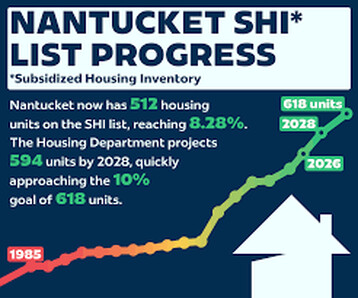
Right now, the state says that Nantucket needs 618 units of subsidized housing. It is close to that goal. In August, the Affordable Housing Trust reported that Nantucket had 512 units of subsidized housing and was on track for 594 units by 2028. The concern is that the necessary amount of subsidized housing could spike in 2030, after the next decennial census, when the numbers are recalculated. But if Nantucket’s population growth is slow, or perhaps even stalls completely, that may not happen.
"I'm curious to see when the next census comes out if we're not already at the 10 percent," Select Board member Bob DeCosta said at a recent Select Board retreat. "The last time we did [the census] it was during COVID, when our numbers were elevated."
DeCosta also made the familiar arguments mentioned above that, if more housing is built, it might lead to an increase in Nantucket's population.
If the island's population growth has slowed or stalled, housing advocates will be faced with a difficult choice. How much of their energy should continue to go toward low-income housing, and how much should go toward the so-called “missing middle” of residents who do not qualify for housing on the subsidized housing inventory but still cannot afford a home on Nantucket?
The town of Nantucket has also commissioned its own year-round, seasonal, and shoulder-season population study. The results of that study, conducted by UMass Amherst, may provide the best estimates of Nantucket’s population since 2020. They will not, however, replicate the methodology of past population estimates, meaning that comparisons to census numbers or previous independent studies will be of limited use. The study will use data from the town assessor’s records, as well as water and sewer data and census numbers.
School Enrollment Is Down - But Why?
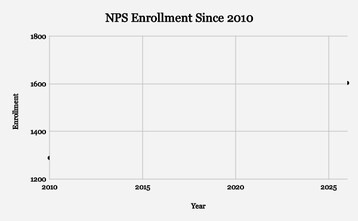
The Current’s investigation began in early September, when the Nantucket Public Schools released data showing that the district’s student population had dropped sharply for the second year in a row. After steadily rising throughout the 2010s, the number of students in the island’s public schools levelled off after the beginning of the COVID-19 pandemic, and the district’s enrollment has now fallen 6.7 percent in the last two years.
The consequences of that decline are mixed. Superintendent Elizabeth Hallett told the Current that some of the state funding the district receives does depend on student enrollment, but lower enrollment can also allow the district to explore new opportunities and reallocate funds as student-teacher ratios fall and the amount of resources required to support the student population drops.
There is no easy explanation for why the district’s enrollment has stopped growing. Hallett pointed to the national political climate and Trump’s aggressive immigration policies, saying that “the political climate has caused some decreases across the state in bilingual students,” but it appears that enrollment had already levelled off during President Joe Biden’s term, and at least last year, the decline in enrollment was most notable in white students. While Nantucket does have many white immigrants, most immigrants to the island are Hispanic or Caribbean, and the share of Nantucket Public School students identifying as Hispanic actually increased from 44.2 percent to 45.9 percent last year, while the share of white students fell by a similar amount.

It could also be that parents are sending their children to private schools, but the decline has not been concentrated in the high school alone, and Hallett does not believe that local private schools have seen an explosion of new students.
If Nantucket’s year-round population has stopped growing—or has perhaps even begun to decline—that could also explain the Nantucket Public Schools’ numbers. But an ageing and still growing population would explain the drop-off just as well. That may be what is happening in Massachusetts at large, where student enrollment has fallen slightly while the state’s population has continued to inch upward, but at a slower rate compared to previous years.
What Water, Sewer, And Electricity Usage Reveals - And What It Doesn't
The public school enrollment numbers were suggestive enough, however, that the Current decided to look deeper. Without the ability to conduct a reliable headcount of Nantucket’s population or access to a data analytics firm, the next-best option is to turn to utilities and public services. Everyone uses water and electricity, and everyone produces waste and sewage. When populations rise, it is usually, though not always, the case that more water and electricity are consumed, and more waste and sewage are produced. The UMass study commissioned by the town will also rely on several of these measures.
Nantucket’s water usage has recently declined sharply, but it is unlikely this has anything to do with the island’s population. Instead, the decline is likely driven in large part by the drought that has gripped the island and the water usage restrictions that have come with it. It is notable, however, that Nantucket’s water usage showed some signs of peaking before the drought. After years of steady increases, Nantucket’s annual water withdrawal remained essentially level and actually marginally decreased from 2023 to 2024, which is also when Nantucket Public Schools' enrollment reached its all-time peak.

Additionally, many new appliances and household fixtures are more efficient than previous versions, which could also contribute to a drop in water usage. Given that sewer volume is largely a product of water consumption—much of the water used by households on Nantucket ends up flowing back through sewer pipes—when water usage falls, sewer usage often follows.
On the other hand, Nantucket’s electrical usage is higher than ever. Data shared with the Current by National Grid shows that Nantucket’s monthly electrical usage peaks have continued to climb since 2020.

Electricity use fluctuates from month to month as the weather changes and tourism to the island shifts, meaning that it is best to compare the same month each year. For example, in October of 2020, Nantucket’s total peak demand on the grid was 25.9 megawatts. In October of 2025, it was over 30 megawatts. There is a lot of noise in these numbers, and the total peak demand in October of 2024 was 26.5 megawatts, not much higher than the figure for 2020, but over a large enough sample size, some of this noise smooths out. Standard tests of statistical significance show that the odds of seeing growth as, or more significant than, what was observed in the data shared by National Grid as a result of chance alone are less than 4 percent.
Nantucket’s electricity usage is highest in the summer, and National Grid’s data shows the island hitting a new all-time demand peak of 56.3 megawatts in July 2026. Notably, while National Grid’s data shows peaks previously reported by the Current of 54.1 megawatts in 2025 and 54.8 megawatts in 2024, it does not include the peak of 57.2 megawatts that Bluedot Living reported Nantucket had hit in 2022. Instead, the highest peak included in National Grid’s data for 2022 was 54.6 megawatts, reached on the same day as the peak cited by Bluedot Living.
However, the upward trend in electrical usage actually appears to be more statistically significant after stripping out the island’s peak season and looking only at the data for October through March.

The increase even remains significant after removing last year’s unusually cold winter, which saw electricity usage spike as islanders attempted to keep their homes warm while temperatures plummeted.
There are, however, plenty of explanations for this trend other than an increase in Nantucket’s population. Electrical usage is dependent on the weather, and more electricity is consumed when it is particularly hot or cold. Since 2020, Nantucket has seen both particularly hot summers and at least one particularly cold winter.
It is also dependent on the personal choices of individuals, perhaps most importantly home heating methods. The share of homes reliant on electric heat has continued to climb in recent years, while the fraction of homes using natural gas has declined. This could go a long way to explaining why Nantucket is using more electricity, especially in the winter, when it appears that the increase has been the most notable.
It’s also possible that, despite removing the summer months from the equation, vacation home development is still responsible for Nantucket’s higher electrical usage. Vacant homes still need to be heated during the winter to prevent pipes from freezing and protect temperature-sensitive building materials. Additionally, if off-season tourism to Nantucket is increasing, even if overall levels remain low, it could be enough to tip the scales and lead monthly peak demand levels to appear higher not as a result of a growing year-round population but because campaigns promoting travel to the island during the fall and spring have been successful.
Trash Transparency
Another source of data is what the Department of Public Works calls municipal solid waste. In other words, household trash. The Department of Public Works provided the Current with detailed waste data across a variety of streams dating back to 2016. Much of this data is not especially useful for judging Nantucket’s population. The amount of leaf and yard waste the landfill has received, for instance, has little to do with the island’s year-round population (though it may be of interest that the figure appears to be trending fairly conclusively downward since 2021).
Municipal solid waste, however, is correlated with population, and no matter which months are considered, the amount of household trash deposited in Nantucket’s landfill does not appear to be increasing.

Full-year, off-season, and month-by-month comparisons show that the amount of municipal solid waste the landfill has processed since 2020 is flat or declining.

Again, this does not mean Nantucket’s year-round population is also flat or declining. There are many other factors that also influence trash production, including income and economic conditions, though both of those would seem to suggest that Nantucket’s municipal solid waste should be increasing: median incomes on the island are only rising, and most economic signals suggest that today’s economy, while perhaps not strong, is better than the pandemic-driven recession of 2020. Still, seasonal residents fleeing COVID-19 could have temporarily driven up waste production in 2020 and 2021, leading to the island’s all-time peaks, and it could be the case that Nantucket residents have reduced their consumption for other reasons unrelated to economic conditions.

Ultimately, the data is inconclusive. There is no way to know for certain whether Nantucket’s year-round population is increasing, stable, or decreasing. If it is increasing, there is no way to know if the rate of growth has slowed or not. This inconclusiveness itself, however, is notable. Six years ago, a similar review of the data would have painted a much clearer picture, with nearly every arrow pointing unambiguously up. It may be that the data has simply become more difficult to read, and the results are still the same. It may be that the 2030 decennial census, however unreliable the results, will show another marked uptick in Nantucket’s population. For now, though, the uncertainty is the story.