On Split Vote, Select Board Endorses Coastal Resilience Districts For Nantucket
JohnCarl McGrady •
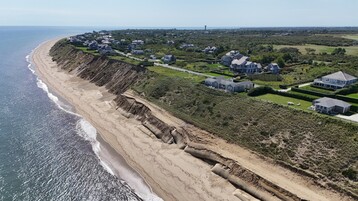
The Select Board voted 3-2 to endorse a plan to establish Coastal Resilience Districts on Nantucket at its meeting on Wednesday. The districts will be used to assess fees known as betterments on island residents who stand to benefit most from certain coastal resilience projects.
No specific districts were established on Wednesday, and no particular projects were singled out for funding. Sustainability Programs Manager Vince Murphy said that the districts would only be used to fund the smaller projects in the town’s nearly $1 billion coastal resilience plan, not the larger projects, some of which cost more than $100 million.
“This will fix the smaller projects and give people hope. That is a very big thing with this project,” Murphy said. “This is making it into a joint effort between the town and homeowners.”
Any project proposed to be funded by betterments will need approval from the Select Board, and then from Town Meeting, as voters in 2024 shot down a proposal that would have given the Select Board more blanket authority to assess betterments. Under the framework endorsed by the Select Board, the intention is that any projects funded by betterments would also need broad support from the property owners who would have to pay those betterments.
“The way I see this is it is a way for us to manage projects that are, clearly, the benefit is shared between private property and public assets,” Select Board vice chair Brooke Mohr said. “I don’t want to expend our time on bringing forward a project if we don’t have buy-in from the people who are going to pay in advance.”
The Select Board amended the framework to specify that 60 percent of homeowners impacted by the betterments for any project brought forward by a particular neighborhood will need to agree to the betterments before a project can be considered.
Some Select Board members worried that, even if the project was supported by most of the homeowners in an area, residents could agitate to remove the betterments clause on the floor of Town Meeting.
“Can we get to Town Meeting, having an agreement that we’re going to assess betterments, and then have it be amended on Town Meeting floor?” Select Board chair Dawn Hill asked. “We can’t be sure that that won’t happen.”
Ultimately, Hill, Mohr and Select Board member Matt Fee voted in favor of the plan, while the Select Board’s two newest members, Jill Vieth and Bob DeCosta, voted against it.
“I’m a no because I think we’re instituting a really burdensome government process I’m leery of,” Vieth said. “We’re relying on other committees and people who I don’t think are experts to determine these things, and then it bubbles up and I’m uncomfortable with that.”
The framework also specifies that any projects would need to have a public benefit.
“If we don’t do something like this, but we are forced to do some of these projects because there’s town infrastructure, and it’s all on the tax base, then everyone does pay,” Fee said. “I’d like there to be some forward motion on this.”
DeCosta, who has repeatedly criticized the town’s coastal resilience efforts, slammed the proposal Wednesday. Among other criticisms, DeCosta raised concerns about the cost of betterments being passed from landowners to renters—or assigned to property owners who do not really benefit from the projects in question—and suggested the town should be less involved to save operational capacity and funds, allowing private homeowners to handle projects on their own.
“I think this is going to turn into a cash cow for our consultants,” DeCosta said. “Until we actually have one project come through this as a pilot program, I wasn’t going to vote in favor of this.”
Supporters of the coastal resilience districts argue that betterments are fairer than indiscriminate taxes, allowing the residents who benefit the most to contribute the most while islanders who won’t be served by certain coastal resilience projects, which often have geographically limited impacts, don’t have to pay for them. It also allows the town to be more involved than they are with fully private coastal resilience projects.
“This is just a framework,” Murphy said. “This brings control back in so that we have a stake, have an ability to make these run properly.”
DeCosta also suggested that the town’s natural resources department staff is unqualified.
“No one in the natural resources department has the qualifications to run this project,” he said. “There’s so many unanswered questions with this.”
Murphy rejected DeCosta’s characterization.
“I am qualified,” he said. “You hire experts to work within the town. We do our jobs. We are the people you should be relying on.”
Murphy has a master’s degree in ecosystem conservation and landscape management. The other two town staff members most closely associated with the project also have advanced degrees. Town natural resources director Jeff Carlson has a degree in natural resources and a post-graduate certificate in public administration.
Although Town Meeting denied the Select Board blanket authority to assess betterments in 2024, voters did endorse the creation of the coastal resilience districts.