Who Will Pay For Coastal Resilience Projects On Nantucket?
JohnCarl McGrady •
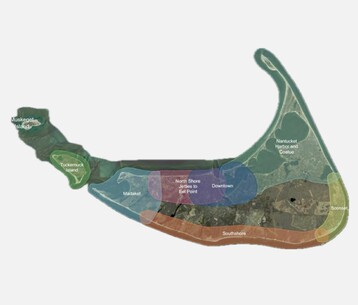
After more than three years of discussions and votes, the Select Board will consider a plan to establish Coastal Resilience Districts on Nantucket at its meeting on Wednesday.
The primary purpose of the new districts is to assign the cost of certain coastal resilience projects to the property owners who will benefit most directly, reducing the cost to the rest of the island’s taxpayers. In practice, however, it may be difficult to use the districts for this purpose initially. While Town Meeting approved the creation of coastal resilience districts in 2024, voters balked at using them to assign the costs of coastal resilience projects to homeowners within the districts and shot down a proposal that would have given the Select Board blanket authority to do so.
One of the loudest voices against betterments in 2024? Bob DeCosta, who now sits on the Select Board and has spent the first four months of his term criticizing coastal resilience projects and advocating against many of the proposals that coastal resilience districts might be used to fund.
Nantucket’s coastal resilience plan includes nearly $1 billion in recommendations, a sum that nearly single-handedly matches the town’s entire 10-year capital improvement plan, which itself is highlighted by a series of nine-figure coastal resilience expenses.
Coastal resilience districts offer a way to ensure that taxpayers don’t collectively bear the entire cost of the coastal resilience plan. Instead of paying for every project using debt overrides, some could be paid with betterments, special taxes assessed only on the property owners who will benefit directly from the projects. Supporters of this system also argue that betterments are fairer than indiscriminate taxes, allowing the residents who benefit the most to contribute the most while islanders who won’t be served by certain coastal resilience projects, which often have geographically limited impacts, don’t have to pay for them.
But at the 2024 Town Meeting where the districts were endorsed, and blanket approval for betterments was rejected, DeCosta worried that betterments would unfairly raise taxes on islanders who own homes near the waterfront and already pay the bulk of Nantucket’s property taxes. He also raised concerns that large corporate landowners would pass the betterments on to the small local businesses who rent their buildings, destabilizing commerce and harming Nantucket’s business owners. DeCosta made a motion to postpone a vote on the betterments scheme, which passed 178-137.

DeCosta has also criticized Nantucket for using aggressive sea-level rise forecasts. There is broad scientific consensus that human-caused climate change will drive sea-level rise across the country, including on Nantucket. The island has already seen nearly nine inches of sea-level rise since 1950, and even the most conservative predictions show that figure tripling in the next 75 years, which would have significant economic, environmental, and human consequences for Nantucket.
But there is a high degree of uncertainty about how much sea levels are likely to rise. The National Oceanic and Atmospheric Administration’s sea-level rise projections provide an illustrative example of this uncertainty. In the high sea-level rise scenario, the water level could rise another 6.66 feet by 2100. In the low sea-level rise scenario, the water level could rise by less than 2.5 feet. The difference between those figures is enormous and could represent hundreds of millions of dollars in taxpayer funds either saved or spent. Other models give even more extreme figures in either direction.
Nantucket tends to use the model that gives the largest numbers out of caution, which is necessary to receive state funding. That decision has drawn sharp pushback from DeCosta and other elected officials worried about the cost and scope of the island’s coastal resilience plan. In many cases, using smaller sea-level rise numbers could slash the cost of the recommendations in the coastal resilience plan, even accounting for a lack of state funding—though supporters of the aggressive approach have warned that, if the larger numbers turn out to be right, those savings will be quickly eclipsed by the cost of the damages from the rising seas.
DeCosta’s stance represents how the debate about coastal resilience districts—and coastal resilience more broadly—has changed on Nantucket. When the districts were first proposed in 2023, the proposal was unanimously endorsed by the Select Board and the Coastal Resilience Advisory Committee with little controversy, and some were pushing to move coastal resilience efforts even faster than the proposed process would allow. It is unlikely that things will go as smoothly this time around.
As it stands, the town would need Town Meeting approval to use betterments to fund any coastal resilience projects, even if the Select Board does approve the creation of coastal resilience districts.
Town Meeting has been skeptical of betterments at times. At last spring’s Town Meeting, voters amended a plan to bring sewer to the Somerset area, removing a clause that would have funded the project largely through betterments. Still, voters may view specific coastal resilience projects differently.
The current request before the Select Board is just to endorse the framework for establishing coastal resilience districts, but if they do so, they will soon be asked to choose a project to fund using the districts. That project will then have to go before the voters at Town Meeting.
In a presentation included in the Select Board’s agenda packet, the Natural Resources Department proposes one broad coastal resilience district, divided into a number of sub-districts that would be used to assess betterments.