Request To Lift Short-Term Rental Restrictions In Richmond Development Denied
JohnCarl McGrady •
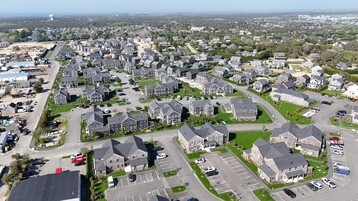
The Select Board voted unanimously on Wednesday to oppose a request to lift a prohibition on short-term rentals (STRs) in a portion of the Richmond Great Point affordable housing development.
Select Board members and community leaders were sharply critical of the request, which sought to reverse a condition of the memorandum that allowed the town’s largest affordable housing development to go forward over a decade ago.
"The intention [was] to make this development as much a year-round community as possible," Select Board vice chair Brooke Mohr said. "Density bonuses and other things were granted by the Select Board at the time in exchange for that agreement in the [memorandum of agreement], so I am disinclined to change this."
Nantucket Property Owners, a real estate investment company that purchased 36 lots in the Richmond development’s “Sandpiper” subdivision in 2022, had requested the Select Board to lift the ban, calling it “inequitable” and “squarely at odds with what Town Meeting voted for and what the Attorney General has now affirmed as valid Town policy.” They claimed that the ban unfairly burdened homeowners in the Richmond development by placing a restriction on them that does not apply to most other island homeowners.
"We do view such disparate treatment as arbitrary and inconsistent with the uniformity and equal protection principles underlying Massachusetts zoning law," Nantucket Property Owners attorney Johanna Schneider said. "More importantly, as a practical matter, the differential treatment of this property through continued enforcement of the short-term rental restriction is chilling the sale of the remaining ownership units."
In their letters to the Select Board, they referred to a landmark Town Meeting vote last November, which clarified Nantucket’s zoning regulations by explicitly codifying STRs as an allowable use in almost all of the island’s zoning districts. That vote ended the stalemate on the legalization of STRs that had dominated local politics for years, but it did not ban the town, private developers, or homeowners associations from blocking STRs on certain properties.
In fact, several major housing developments on Nantucket, including Sachems Path and Abram’s Quarry, ban STRs outright. Additionally, STRs are blocked in essentially every deed-restricted affordable housing unit on the island, and a number of local homeowners associations have policies that disallow STRs.
Select Board member Bob DeCosta added that, while STRs had not been codified as a legal use in Nantucket’s zoning when the memorandum was reached, they had also not yet become a hot-button issue on the island, and legal challenges had not emerged. He said that Nantucket Property Owners were aware of the restriction when they bought into the development, and that it should not be lifted.
"It was strictly understood that there would be no short-term rentals in here," DeCosta said. "At the time, short-term rentals may not have been a zoning right, but they were a right on Nantucket. No one was questioning short-term rentals. Anyone who wanted to rent their house rented their house."
Richmond attorney Andrew Burek told the Current that Richmond itself is “not involved with the efforts” and “takes no position” on the issue.
Supporters of STR restrictions in affordable housing developments contend that they help ensure homes remain occupied by year-round residents, rather than entering the vacation rental pool. In the Richmond development, subletting is also banned for similar reasons. STR bans also help neighborhoods retain a year-round, residential character.
"The STR restrictions in Richmond were imposed to increase the amount of lower-priced homeowner and long-term rental opportunities on the island available to year-rounders, and of course it is also worth noting that opening all these homes to STR activity will bring with it the usual burdens of traffic - this is Old South Road, after all; parking, which has been a problem for Richmond in the past; a party atmosphere in a high density community, which we know well in Naushop, where STRs are not prohibited; and finally, the increased burden on the town staff charged with enforcement," Naushop homeowners association chair Scott Wilson said.
But although Richmond is the largest affordable housing development on the island by a large margin, most of the housing in the development is actually comprised of market-rate units. All of the units, even the affordable ones, can be difficult for some local families to afford, and STRs are one way for residents to generate additional income to help pay for their housing.
It is also notable that islanders who live in affordable housing—ostensibly, those who most need additional income—are the most likely to not be allowed to rent their homes short-term.
For now, the Select Board’s adamant opposition to the real estate company’s request will likely deter similar requests in the future. The disincentive will be stronger than just the sting of defeat: Select Board chair Dawn Hill, who usually recuses from requests related to STRs but did not do so Wednesday, said that she was glad the request was brought to the Select Board because it opened up an opportunity for the town to crack down on illicit STRs in the Richmond development, which she said she has seen listed on rental websites.
"We need to get a handle on the enforcement of this restriction," Hill said. "I have seen short-term rentals advertised, and I think in many ways it's good that it's come to light."