Nantucket's Flock Cameras Taken Down After Select Board Votes Unanimously To Remove Them
JohnCarl McGrady •
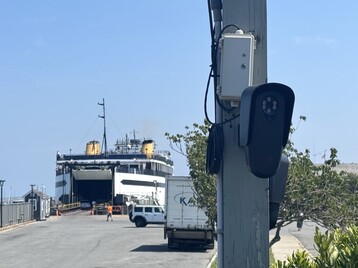
Nantucket’s Flock cameras have been taken down.
The Select Board voted unanimously on Wednesday to stop the use of the controversial automatic license plate readers at the corner of Easy Street and Broad Street, joining a growing wave of towns across the state and the country that have ended contracts with the surveillance company.
On Thursday morning, deputy police chief Charlie Gibson was spotted removing the cameras in a bucket truck:
Here is Nantucket’s deputy police chief Charlie Gibson taking down the Flock cameras at sunrise this morning: https://t.co/VGSARdbPHP pic.twitter.com/AAwzQBpuCg
— Nantucket Current (@ACKCurrent) September 17, 2026
"I was following the poll put out by the Current, I'm following what's happening in other communities, and a lot of people are just voting to cancel this project," Select Board chair Dawn Hill said, referring to our Instagram poll in which 1,437 people voted over 24 hours. Eighty-one percent supported the removal of the Flock cameras.
However, the Select Board left the door open for the police department to come back with an “alternative technology” to replace the cameras.
"My concern here is: what do we lose in terms of policing if we take away this tool?" Select Board member Brooke Mohr said. "If we're going to remove these, I would like the police chief to consider an alternative version of this that would then be vetted more broadly among the community if we decided to bring it back."
While the Nantucket police department has continued to maintain that the cameras are a useful law enforcement tool and has provided examples in which information collected from the cameras helped to solve crimes on the island, an outpouring of public opposition and the same privacy concerns that have been lodged against Flock nationwide led the Select Board to instruct the department to end its contract with the embattled company and remove the cameras.
Critics claim that the cameras function as mass surveillance, recording huge amounts of information about every car that passes by. This data is then vulnerable to exploitation by police officers, who have used Flock cameras as personal stalking tools in many high-profile off-island cases. It is also vulnerable to cyberattacks. The police department has so far declined to share any details about the effectiveness of its cybersecurity measures in response to community concerns and questions from the Current.
"Flock, the company, is not trustworthy," said community advocate Mary Longacre, who serves on several town boards. "They have been documented to have violated terms of contracts with towns. They have shared information that is not known to the town that it's being collected."
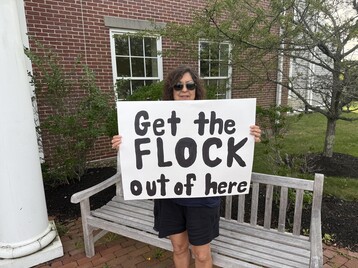
Chief of Police Jody Kasper continued to defend the use of the cameras during Wednesday's Select Board meeting.
"When we go to victims of crimes, they want them solved, whether they've been hit by a car or something has been stolen, and we want to solve them for them," Kasper said. "We don't have a ton of resources. We are a small police department doing our best to keep up with the demand from the community. We want to solve those, and by solving those and bringing closure to that victim, we hopefully prevent it from occurring to another victim."
Kasper will, however, have the chance to convince the public about alternative technologies, as the Select Board required that any replacement surveillance tool the department identifies to replace the Flock cameras would have to go through a public feedback process.
The town initially purchased the Flock cameras at the administrative level without going before the Select Board, and installed them in 2021, though the exact installation date is unclear. The town has said the cameras were installed in September of 2021, but photos obtained by the Current show the cameras in place at least a month earlier.
Over the last several months, dozens of cities and counties across the country, including dozens of municipalities in Massachusetts, have rolled back automatic license plate reader programs under pressure from local residents. Massachusetts is also considering restrictions at the state level.
A separate automatic license plate reader contract for cameras inside police cruisers remains in place. That contract is not with Flock.
The Select Board is also planning a further discussion about surveillance technology that is governed by the town at a future meeting.