After Hearing Opposition To Flock, Select Board To Vote On Controversial Cameras
JohnCarl McGrady •
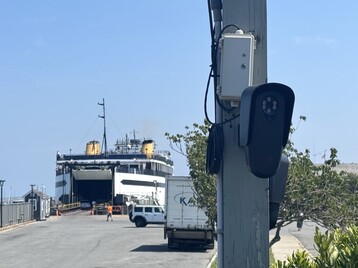
The Select Board discussed the controversial Flock cameras installed at the intersection of Easy Street and Broad Street on Wednesday. A vote on the cameras is now scheduled for next week’s meeting.
Wednesday’s Select Board meeting was much more restrained than some of the more colorful municipal meetings related to the cameras that have occurred in Massachusetts and elsewhere, but a large number of island residents did turn up to oppose them.
"Flock has been caught turning on cameras that local municipalities had turned off, providing data to organizations without the knowledge of the municipality," island resident Mary Longacre, who serves on a number of local government boards, said. "I don't think the benefit...is worth the potential for the abuse of the information and the abuse of their use that is clearly there."
Not a single member of the public spoke in favor of Flock.
"I'm so against these. I think these are an invasion of our privacy and mass surveillance," Lucy Hehir said. "We're a small island. We don't need them. We have a great police force. It's just all these rights are being taken away."
The town of Nantucket has so far maintained that the cameras are a useful law enforcement tool, and has cited at least one example of the technology being used to locate a car involved with a hit-and-run accident last November. Chief of police Jody Kasper added that the system has recently been used to determine that a man involved with a domestic abuse case was no longer on Nantucket. Flock claims its technology has helped locate thousands of missing people and cars.
"It's a strong investigative tool. We rely heavily on our [automated license plate readers] to help us solve crimes," Kasper said. "What we would see is less conclusion for victims of crimes. We would be less likely to be able to solve some."
But critics have pushed to remove the cameras, arguing they violate the privacy of law-abiding citizens by recording large amounts of data on every car that passes by. Perhaps the most notable evidence for these security concerns is the recent revelation that, in many high-profile off-island cases, police officers have used Flock cameras as personal stalking tools.
"The scope of information it's collecting is so much wider," island resident Natalie Kaufmann said. "It's not necessary."
At Wednesday’s meeting, Kasper acknowledged that towns can sometimes get ahead of themselves when they adopt new technology.
"In some cases, it's certainly possible that communities can kind of get ahead of themselves and get technology before proper policy or even discussion has been had about that technology," she said. "It's a good discussion to be had in the community."
In response to privacy concerns, Nantucket's deputy police chief Charlie Gibson said that the town needs to trust Flock, which has promised not to sell Nantucket’s data or make it available to other parties.
"I guess you have to assume that they're truthful," he said.
Several island residents in attendance raised concerns about the possibility of personal information gathered by the Flock cameras getting hacked or released inappropriately. When asked by the Current specifically about any recent assessments of the Nantucket Police Department’s cybersecurity and its ability to repel attackers, Gibson, who is responsible for NPD's IT operation, declined to get into specifics
"I don't understand, really, the scope as it relates to the Flock," Gibson said. "On the Flock system, we had done our internal audits on that technology, and we checked every inquiry that was been made to last, basically over the summer, and we didn't find any irregularities. All the inquiries were proper and done in accordance with the standard operating procedure for the system. Now, regarding our entire IT network. I don't think you want to get into that at this present time because that will go on for a much longer meeting."
No vote was listed on the Select Board’s agenda on Wednesday, meaning that even if the members had wished to take a vote, they likely could not have. But Select Board chair Dawn Hill said that the item could be put on another agenda for a vote as soon as next week.
Select Board member Jill Vieth came out against the Flock cameras during the meeting.
"I don't like the Flock camera. I don't want the Flock camera. I'm happy to vote to take the Flock camera out tonight if you all want to. I think that's a really easy thing to do," Vieth said. "At the same time, I don't think the police department has been doing anything untoward with this technology."
Vieth believes the contract with Flock should be put to a vote at Town Meeting, and criticized the police department for not bringing it to the Select Board or Town Meeting previously.
"Do I feel like it should be a vote at Town Meeting? I do," Vieth said. "That way, you can see exactly what it is."
The town also has a contract with Axon, a similar company, for automatic license plate readers installed in police cruisers. Vieth said that this contract did get approval.
The town initially purchased the Flock cameras at the administrative level without going before the Select Board, and they were installed in 2021, though the exact installation date is unclear. The town has said the cameras were installed in September of 2021, but photos obtained by the Current show the cameras in place at least a month earlier.
Over the last several months, dozens of cities and counties across the country, including 25 municipalities in Massachusetts, have rolled back automatic license plate reader programs under pressure from local residents. Some have switched to companies that have generated less controversy than Flock, while others have ditched the technology entirely. The pushback to the cameras has been sharp. Some have been torn down or vandalized. Residents have turned up in large numbers to protest the cameras in small towns and major cities, fueling a rare moment of bipartisan unity: Flock’s strikingly low favorability is equally poor with both Republicans and Democrats.
On the state level, Texas has ordered a stop to all funding for Flock cameras, and Florida is removing them from all state roads. Several other states are considering strict regulations or bans on the technology. In Massachusetts, the state legislature is also considering restrictions.