Schools Considering "Last Resort" Options As Bus Driver Shortage Persists
JohnCarl McGrady •

The Nantucket Public Schools are still facing a critical shortage of bus drivers. If nothing changes soon, the school system may have to completely stop all bus service for grades 7 through 12 and stop allowing all students living within two miles of the schools to ride the bus.
“This is absolutely critical. We cannot function this way,” Superintendent Beth Hallett told the Current.
The long-simmering bus driver shortage, which the Nantucket Public Schools have struggled with for years, reached an inflection point this spring. With only one remaining driver able to drive a classic “big bus” school bus in the morning and afternoon, the schools were left asking students to find other methods of transportation. The bus stopped going to Madaket entirely, and by the end of the year, some students had to wait over an hour to get home at the end of the day.
“We desperately need more bus drivers. We have had a recruitment issue and a retention issue. It’s a great job, I just wish it could pay more,” School Committee member Vince Murphy told the Current. “We have had issues all through the last school year, and, unfortunately, it looks like it might persist, and we’re trying to find ways to proactively find drivers.”
Now, with few alternatives available and no relief on the horizon, the Nantucket Public Schools are left contemplating drastic options. Several high-ranking staff members, including Superintendent Beth Hallett, are getting licensed to drive smaller vehicles as school buses. It’s possible some students will be driven to school next fall by the district superintendent, but that alone won’t solve the problem, as the vehicles Hallett and the other staff members are getting licensed for simply cannot carry enough students.
Right now, students within 1.5 miles of their school are not eligible for bussing. The School Committee may need to expand that perimeter to 2 miles.
The School Committee may also need to stop bussing every student in grades 7 through 12, forcing the entire high school and the oldest students in middle school to find other ways to get to and from school. Most of those students can’t drive, and for children whose parents go to work early or don’t leave until late, their options might be slim.
“This is how restrictive we might have to get to ensure services for the most needy children,” Murphy said.
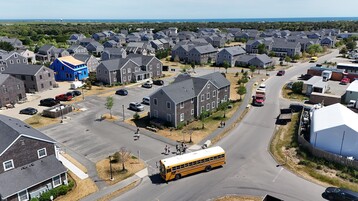
Blocking older children from riding the bus could also raise other concerns, including younger students with older siblings returning home alone to empty houses. School Committee members suggested in a recent meeting that exceptions would have to be made to avoid these situations—but every exception would eat into the available seats.
Hallett called this “the very last resort.”
Unless someone intervenes, however, there might not be another choice. Murphy said that the schools are “pleading” with the community for support. Even one driver certified to drive a big bus could make an enormous difference. The Nantucket Public Schools has offered to help candidates with transportation and logistics for the necessary tests, and Hallett said that there is also a bonus available.
“I would hope that someone comes and saves the day,” Hallett said. “We are trying very hard.”
The Nantucket Public Schools do not handle their own busing operation: they contract with the Cape Cod Collaborative to recruit, hire, and retain drivers. But Cape Cod Collaborative has been unable to find drivers, and has admitted that they can’t provide the quality of service that the school system needs. The public schools are now looking at bidding out the service to other potential operators.
One issue is bureaucratic. Anyone who wants to get a license to drive a big school bus has to go off-island to train and test on a “long-nosed” school bus with an extended hood. Nantucket only has “flat-nosed” buses, meaning that drivers can’t train on-island, even though the knowledge they gain from that training will be irrelevant to their actual job.
Transporting children also requires certain licenses that drivers with groups like the Nantucket Regional Transit Authority do not have, thwarting several potential alternatives.