Should Nantucket Raise The Residential Tax Exemption? The Select Board Appears Split
JohnCarl McGrady •

Select Board members expressed mixed feelings on the possibility of increasing the residential tax exemption during their meeting on Wednesday, leaving it unclear if they will seek to reduce the tax burden on year-round homeowners when they vote to set the rate again this fall.
The residential tax exemption is a complex legal tool that Massachusetts towns can use to shift taxes from owner-occupied residential properties, primarily those with lower property values, to vacation homes, higher valued homes, and other residential properties not occupied primarily by the owner, including apartments and vacant land. It sets aside a portion of the value of all owner-occupied homes, exempting that portion from local property taxes. To ensure that the overall tax levy remains the same, the remaining value of the homes within the residential tax class is then taxed at a higher rate.
Select Board member Brooke Mohr suggested that increasing the exemption would help reduce costs for year-round residents who may be struggling to pay ever-increasing tax bills.
“I think with all of the capital projects that are coming, and what was voted, that my concern is for folks who are on fixed incomes or moderate incomes,” Mohr said. “My thinking is, can we provide a little bit of protection for folks who are struggling to stay as their property values go up?”
But other members of the Select Board disagreed. Jill Vieth, who said she supported an increase during her campaign for office earlier this year, reversed course and came out against upping the exemption Wednesday, citing the impact on rental properties, which are not covered.
“I worry about the people who have multiple homes who are running businesses, who are trying to rent those for employees, and it just increases the amounts on them,” Vieth said. “Originally, I was in favor of it, but after doing my research, I think I'm kind of landing on sticking close to where we are.”
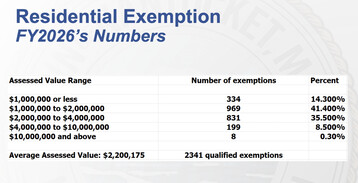
For years, Nantucket’s residential tax exemption has been set at 25 percent. The Select Board voted again to hold it steady last December, keeping the option to increase it in reserve in part to cushion the impact should voters endorse a large amount of spending.
But voters just endorsed over $200 million in borrowing this year, and the Select Board is still divided on whether to increase the exemption.
“I'm going to go on the record right now and say that I don't support any raise in the exemption,” Select Board member Bob DeCosta said. “This only helps the people that own a home. The majority of the people in this town rent a home, and the landlord is just going to pass the rising taxes on to the tenant, and they're not going to get the exemption.”
In fact, DeCosta cited the high borrowing, previously given as the main reason the exemption could be increased, as a reason to hold it steady.
“The majority of the people that are going to benefit from this are the ones that came to Town Meeting and voted through all these expenditures,” he said. “I want everyone to feel the pain.”
Select Board chair Dawn Hill suggested the possibility of a formula that could be used to tie the exemption to the town’s debt, increasing it as borrowing increases and then reducing it as borrowing lowers—if it ever does.
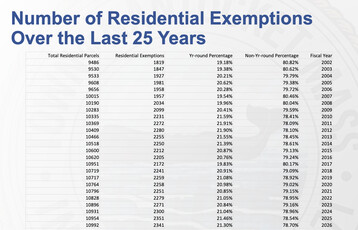
With Hill and Mohr expressing support for some kind of increase, and DeCosta and Vieth openly opposed to it, Select Board member Matt Fee’s vote will be key. Fee seemed skeptical of increasing the exemption on Wednesday.
"I'm not sure that if we went to 30 or 50 [percent], that this is really going to impact” the tax burden caused by rising property values, he said. “I think we have to be thinking, are there other ways to tackle this?”
While it’s still uncertain how the Select Board will vote next fall, and there is time for any of the five members to change their minds, that could mean the most likely outcome is that, despite signaling that they would consider increasing the exemption if voters backed major spending items at Town Meeting, the Select Board will hold the rate steady once again.
The maximum allowed residential exemption, now that Nantucket is designated as a seasonal community by state law, is 50 percent. The exemption is based on the average residential value for the island, which is currently $3,597,109, meaning that a 25 percent exemption shaves $899,277 off a qualified property's value for property tax assessment purposes.
A 30 percent exemption would shave $1,079,132 off the average Nantucket home’s value. A 50 percent exemption would fully cut $1,798,555 from the valuation when property taxes are calculated. However, the residential tax exemption cannot reduce a property’s assessed value below 10 percent of its actual value.
The residential tax exemption is sometimes misunderstood. It does not impact the tax rate for commercial property. The percentage of the tax levy paid for by residential property remains constant regardless of the exemption rate. Increasing the exemption only affects which residential properties are responsible for that levy.