Sperm Whale Washed Up On Beach Owned By Chair Of Woods Hole Oceanographic
Jason Graziadei •
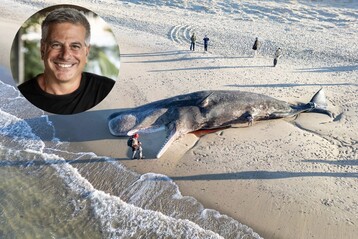
The improbability of a dead sperm whale washing up on the north shore of Nantucket last month was exceeded only by the implausibility of the identity of the property owner where the cetacean ultimately beached.
The 52-ton carcass just so happened to come ashore at the beachfront property of Paul Salem, the chair of the Board of Trustees at the Woods Hole Oceanographic Institute (WHOI), one of the world's leading non-profits dedicated to ocean science.
"You can't make it up," Salem told the Current over the weekend. "I mean, I chair the board of the Woods Hole Oceanographic Institute, the world's largest oceanographic organization, and I've got a dead whale in my backyard?"

Salem, a private equity executive who lives year-round in Rhode Island, has owned his Nantucket property for nearly 20 years. During that time, he's seen many things wash up on the beach in front of his summer home: boats, seals, snow fencing, and other erosion-control devices, to name a few. It is so common he sometimes refers to the property as "the Eel Point dump." But never did he expect to see a large whale - let alone a rare sperm whale - wash up at this property.
"My friends, they just kept on sending pictures and saying, 'Look at the size of this whale!' And honestly, I was out of town, so I couldn't," Salem said. "I wanted to come see it because I'm sure this will be the last time ever - I hope it's the last time ever - and the scale of it was really hard to tell until, I think you guys had a picture of it with the mouth open. But it really is hard to imagine how big it is."
Given his interests in ocean science and marine mammals - which ultimately led him to a leadership position on WHOI's board - Salem said the incident hit close to home - literally and figuratively.
"My passion is not only protecting oceans, but I'm a big, big believer that whales are literally the most important mammal, the most important species in the ocean," Salem said. Whales make the oceans healthier. They create the giant mixing bowl for the ocean. I don't know if people really understand how important whales are, and to have an active whale population is clearly the most important thing."
After the initial shock of the situation had subsided, Salem said his property manager on Nantucket, Dorothy Hertz, contacted him to say she had been in touch with town manager Libby Gibson regarding the town's plans to dispose of the carcass offshore by transporting it by tugboat.
"And I think Libby asked, you know, would we be okay helping out?" Salem recalled.
"And I said, 'Of course.' So I said I would split it. And she said she thought it would cost 24 grand. So I said, I'll happily send 12."
Town of Nantucket communications manager Florencia Rullo told the Current: "The property owner is the Chair of the Woods Hole Oceanographic Institution and cares deeply about whales and the ocean. He conveyed that he appreciates the care and outpouring of concern for the ocean’s most significant mammals."
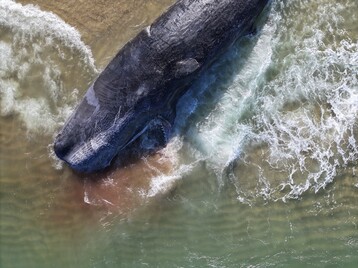
Now, Salem said, two unresolved questions continue to nag him: how did the whale end up at the unlikely final resting spot on the north shore, and more importantly, how did it die?
"Why would it be on the north shore, right?" Salem said. "Whales don't show up on the north shore. We've never seen that, and it's so shallow. How would that whale actually make it onto my beach? There's a three-foot sandbar a few hundred yards out, right? And it's only five feet deep. I'm amazed it made it onto my beach. My bet is it came in on a northeast breeze."
Like many others who have been following the story, Salem has been seeking out any information regarding the cause of the whale's death. Marine mammal specialists from the International Fund for Animal Welfare (IFAW) and the New England Aquarium performed a window exam on the whale's carcass before it was towed out to sea, but did not observe any obvious cause of death. They are awaiting lab results on samples taken from the whale that could yield additional information.
My guess is that it could have died 100 miles away and the winds pushed it in," Salem said.