Oral Arguments Held At Supreme Judicial Court In Nantucket Teachers' Lawsuit Against Town
David Creed •

Oral arguments in the lawsuit filed by two Nantucket Public School teachers against the town got underway Wednesday morning before the Massachusetts Supreme Judicial Court (SJC) at the John Adams Courthouse in Boston.
The teachers sued the town in May 2025 for its failure to implement the Paid Family & Medical Leave Act after island voters endorsed it for Nantucket municipal workers and teachers during the 2024 Annual Town Meeting. The two teachers who brought the lawsuit - Merrill Mason and the late Page Martineau - had their complaint denied in Nantucket Superior Court earlier this year. Wednesday's hearing before the SJC lasted about 40 minutes, as both sides laid out their cases to the state's highest court.
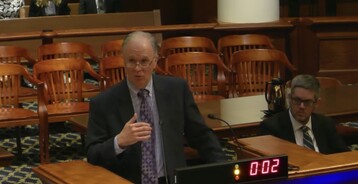
Attorney James Shaw is representing island teacher Merrill Mason and argued that the town has refused to comply with the mandate handed to it by Town Meeting voters in 2024 to implement the PFMLA, and that the town is on the hook for funding the full contribution share until an agreement is made with the unions or there is a bargaining impasse.
"What Nantucket did complied with nothing," Shaw said. "It was sort of a silly, generous idea of what bargaining is, what its obligations were. There were info sessions. They said you either agree to our proposal that you pay the entire full share of your contributions, or we're just not going to implement the statute. None of that was a lawful option for the town on the table. So what the town did complied with no version of collective bargaining at all.”
The teachers argue in their lawsuit that once Article 37 was adopted at Town Meeting, the town administration was obligated to implement Chapter 175M, regardless of whether the teachers’ union, or any union, had agreed to its implementation or bargained for the terms of its implementation pursuant to Chapter 150E (Massachusetts public employee collective bargaining law).

Attorney Joseph Fair represents the town and argued that collective bargaining must occur before the PFMLA can be implemented in any way. He argued that because the town is a single employer, it can’t give benefits to some unions and not others, and that it cannot implement the PFMLA if the other unions are not on board with adopting it. The town argues that it would need to implement Chapter 175M with all unions.
“Before we can implement any benefit in this situation under the legislation as written, we have to ensure we're protecting the rights or honoring the rights, the collective bargaining rights, of the employees that it affects,” Fair told the SJC justices. “I think one of the things that the plaintiff has glossed over, they've really tried to hone this in as when you adopt this benefit, it's a benefit to the employee categorically unequivocally, and that's not actually the case.”
Fair said implementing the PFMLA has impacts beyond deductions. He said there are tax implications even if the town is covering 100 percent of the costs because it has an impact on all town employees' take-home pay. He added that the state’s retirement commission, PERAC, has said that time taken on this type of leave is also not creditable service.
“So essentially, there's a pause in your accruing for retirement purposes down the road in your active approval of that creditable service, so there are negatives potentially that the town has to propose to the unions,” Fair said. “Here's the benefit that Town Meeting adopted. Here is what we're proposing, and we have to do that before we can implement. That is clear in the case law.”
Nantucket voters passed Article 37, a citizen petition sponsored by island resident and town employee Leah Hill, by a margin of 380-112 at the 2024 Town Meeting, which proposed adopting Chapter 175M. The law permits an eligible employee to take certain qualified leaves of absence, including leave to recover from illness. The program is funded by premiums paid by employees and private employers. While towns are not required to participate in the program, they can opt in by a vote of the governing body – in this case, a vote of Town Meeting.
Town manager Libby Gibson subsequently reached out to each of the town's labor unions on July 2nd, 2024, about implementing Chapter 175M and stated that any changes or additions to employee benefits would require collective bargaining under Chapter 150E.
Superintendent Beth Hallett submitted a memorandum on August 22, 2024, on behalf of the School Committee to the Nantucket Teachers Association's president and vice president, informing them that the School Committee wanted to hold information sessions with representatives from the union's leadership regarding Chapter 175M implementation. The following month, the town contacted other municipal unions to confirm their positions on implementing Chapter 175M, and several declined to bargain over the terms of its implementation.
On Wednesday, the SJC justices heard the arguments and then asked questions. Justice Scott L. Kafker in particular appeared to have numerous questions and concerns about the town’s handling of the bargaining process.
Fair said about six of the nine town unions were not interested in the PFMLA benefit. He argued that these unions represent hundreds of employees and that the town can’t upend them or change their agreement to appease a single employee’s desires.
“Some unions had said they don't want it at all," Fair said. "Some didn't give us any explanation, but the fundamental problem with all of this is we have an individual employee that is effectively trying to impose upon all town employees, including all those that have rights under 150E.”
But Kafker said he wasn’t sure that was an accurate description of the situation.
"She's saying you passed this law and you screwed up in its implementation, and had you enacted it, (she) would have had benefits under it,” Kafker said. “Seems like she meets our requirements for standing. She has a distinct interest. She's pregnant or ill, and she would have exercised this. I don't see a standing problem, and if you're not in compliance. I mean, the unions aren't the only ones who have a right to do this. It's the people affected by family leave and medical leave.”
As Fair responded by saying that the whole adoption involves a two-step process and that he believed the Nantucket Superior Court got that right in its judgment, Kafker interjected.
"I agree it has a two-step process," Kafker said. "One, you have to pass the law and two, you have to bargain at least to impasse on it, but you don't have the ability to just say because some of the unions don't like this based on a letter we've sent, and because we're going to require all unions to agree with it, we're not going to bargain with you. I mean, I don't think you can do that.”

Kafker said that while he understands the town can’t charge employees, he noted that $500,000 was appropriated for this benefit at the 2024 Town Meeting. He asked why the Town couldn’t have begun providing this benefit with the appropriated funds – with zero contribution from employees – while the bargaining process was ongoing.
Fair said that, hypothetically, even if something was a net positive for everyone, the town cannot provide the benefit until the bargaining process is complete, reiterating that there would be tax implications as well.
"Even if the town is looking to provide, let's just say we decided we appropriated $500,000 and we decided we want to give $1,000 to every employee in town. We cannot do that unilaterally," Fair said. "That is circumventing the bargaining process. That's circumventing the employee's chosen representative, their collective bargaining representative. So we can't do that, even if it's a net positive to the employee. We're precluded.”
Back in May, the SJC allowed an application for direct appellate review of the lawsuit following an appeal by Mason in April of Nantucket Superior Court Judge Elaine M. Buckley’s denial of the lawsuit in March.
According to the Boston Bar Association, the SJC hears just 200 cases per year. When it comes to cases presented to the SJC such as this one through FAR (Further Appellate Review) applications, the SJC generally hears just three percent of all requests it receives. The SJC is the state’s final court of appeal, with its decisions only subject to review by the U.S. Supreme Court.
Shaw said the town had a “closed mind” in this process.
"What Nantucket could have and should have done if it wanted employees to assume some share of the contributions, is contact the unions and say Town Meeting has made the decision that we are under PFML. That's the new life we are under,” Shaw said. “That's the law. We're making a proposal to you that your members pay this and that. Here's our proposal, and the union would come back and with an open mind, and they should have an open mind, we'll agree to the deductions if we get this better. Then they go back and forth, and they either reach an agreement, or if they don't reach an agreement, and the parties have truly, through good-faith negotiations, reached an impasse, the employer in that case would be permitted to implement its proposal. That's like basic labor law, just in general. That's how it works. That's what Nantucket could have done and should have done, and it should not be allowed here to take its distorted view of 150E to throw the entire statute out the window.”
The SJC will now deliberate and craft its written decision over the next four months. According to the SJC rules adopted in 1978, the case should be decided "within 130 days after argument or after submission without argument."
The statewide Massachusetts Teachers Association in April, speaking on behalf of the Nantucket Teachers Association (NTA), expressed its disappointment with the Nantucket Superior Court’s decision in a statement and indicated they would appeal the Superior Court’s decision and seek access to the same type of paid family and medical leave benefits that Massachusetts law extends to private-sector and state employees.
“We are disappointed with the decision reached in Superior Court to deny a lawsuit brought by two members of NTA when the town failed to act on a motion passed by voters to extend the state’s PFML provisions to municipal employees,” the statement reads. “Our former president Page Martineau was one of the original plaintiffs in the lawsuit. Her fight to have the time necessary to care for herself while being treated for cancer highlighted the need for all workers to have access to paid leave while confronting the extraordinary challenges that arise when needing to care for ourselves and our family members, young and old alike. Page died (November of 2025) as this case was proceeding, and the NTA will carry forward her fight with the Merrill Mason, who joined Page as a plaintiff in the lawsuit.”
Buckley cited several cases as support for her verdict in the case, notably referencing Middleborough Gas & Electric Department v. Town of Middleborough in the written decision. In the Middleborough case, it was determined that providing reimbursement for eye exams and prescription eyeglasses violated the provisions of Chapter 32B because the town didn’t offer the same benefits/relief to all its union employees.
In Buckley’s memorandum, she said that even if the town was incorrect in requiring the uniform adoption of Chapter 175M terms by all unions, Martineau and Mason lack individual standing to seek individual relief.
“The plaintiffs are members of a bargaining unit represented by the Union and therefore lack individual standing to seek relief that imposes Chapter 175M adoption against all members of their bargaining unit,” Buckley says. “Therefore, the plaintiffs’ motion for judgment on the pleadings must be denied.”
Martineau had been a teacher for the public schools since 2003, and Mason has been a teacher since 2014. Martineau was diagnosed with breast cancer in July of 2024 and had to begin taking intermittent medical leave at the beginning of the 2024 school year on September 5th, 2024. Her cancer returned in 2025 and led to her passing in November of 2025, just over six months after the lawsuit was filed.
Mason was diagnosed with breast cancer in 2016 and had to depend on the sick leave bank through her union, although it was not medically advisable. The suit adds that Mason also scheduled a surgical procedure during a February school vacation week to avoid using additional sick days or sick bank leave. She began her maternity leave on January 30, 2025, the same day she gave birth, and used 60 sick days for it. She returned to work on May 12, 2025.