Nantucket Backed Democrats In Mid-Term Election, While Key Ballot Questions Remain Unresolved
Nantucket Current •
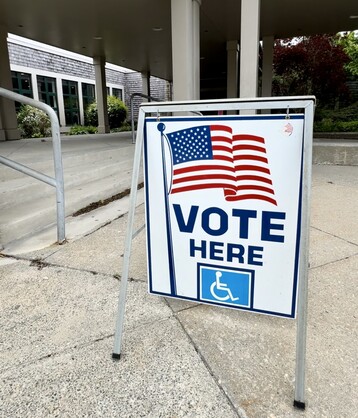
Two key statewide ballot questions remain uncalled in Massachusetts the day after the 2026 midterm elections as votes trickle in from across the Commonwealth.
As expected, Democrats swept the statewide races for elected office that were on the ballot, winning by comfortable margins in every contest. Nantucket joined the state in giving every Democratic candidate a large majority. Nantucket’s representatives in the state legislature, who ran uncontested, also won re-election.
A number of ballot questions that did not appear close in pre-election polling also went as expected. The state—and Nantucket voters—resoundingly rejected an attempt to repeal recreational marijuana legalization and endorsed proposals broadening the state’s public records law, allowing public defenders to join unions, establishing same-day voter registration, creating a dedicated environmental conservation tax fund, and supporting a gun control law previously passed by the legislature.
Question Three, seeking to establish non-partisan top-two primaries in the state, was also soundly rejected, despite a series of polls suggesting a tight race. With some votes still outstanding, the margin appears to be over 20 points. Nantucket voted against the measure as well, but the race was much closer on the island. Nantucket voters broke against the proposal by only 7 points. This was considered the most high-profile race on the ballot, drawing national attention and outsized spending, and creating strange alliances as it divided the Democratic and Republican primaries alike.
Two ballot questions, however, remain too close to call: Question Seven, which would require cities and towns to allow single-family homes on residential lots of at least 5,000 square feet that have 50 feet or more of frontage and access to public sewer and water services, and Question Five, an esoteric proposal that essentially sought to increase tax refunds and reduce government spending on services.
At the time of publishing, Question Seven is a dead heat: “no” leads 50.4 percent to 49.6 percent, with 9 percent of the vote still outstanding. At this point, the contest could easily swing either way. On Nantucket, voters narrowly rejected the proposal 51 percent to 49 percent, which appears roughly in line with the state numbers.
Because many zoning districts have much larger minimum lot sizes than 5,000 square feet, Question Seven would, if passed, increase density in large parts of the state, including much of Nantucket, by mandating smaller lot sizes. Perhaps unsurprisingly, then, the question did best in urban areas, comfortably winning across Boston and in Worcester, Springfield and Lowell, while struggling in large swaths of the state with lower population densities.
Question Five - the one regarding state tax revenue - is also extremely close. With 13 percent of the vote remaining to count, “no” leads 52.1 percent to 47.9 percent. Nantucket voters narrowly supported the question: “yes” came out on top by a mere ten votes.
Some polls had suggested that Questions Five and Seven would pass by large margins. But in the most high-profile poll of the Massachusetts election, the Boston Globe and Suffolk University correctly predicted that both races would come down to the wire. For some spectators following the election closely, that poll, released days before the election, was a striking indicator that a pair of races that otherwise did not appear close would end up being highly competitive. In the end, while the Globe’s poll, like other surveys, underestimated the opposition to top-two primaries in the state, it appears to have been by far the most accurate poll on Questions Five and Seven.
In the Globe poll, Question Five led by 2.4 percentage points, and Question Seven was essentially tied. Indeed, the actual results for Question Seven also show a near tie, and Question Five will be within the poll’s margin of error as well.
Turnout on Nantucket was 5,099 voters, or 48.4 percent of the eligible electorate. Turnout increased by 144 voters from the 2022 midterm elections.