Chris Perry Column: Red, Whiteness, And Blue
Chris Perry •
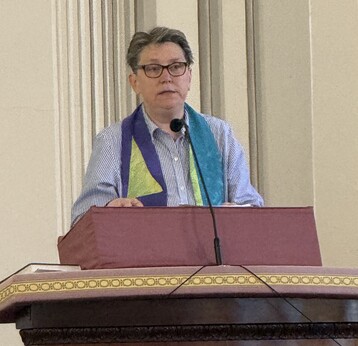
Despite the community’s immediate and emotional response, I knew I needed some time to prepare.
I wanted to clear my mind, organize appropriate questions, and do some research, knowing I was going to write this column. So, after letting things marinate for a while, I decided to take Reverend Erin Splaine up on her offer.
We met in the Unitarian Church on Orange Street. I was surprised to hear that no one else from the Nantucket community had reached out to her to “engage further,” and I think that stung a little. Nevertheless, after exchanging pleasantries, we dug right in.
I listened…a lot.
Leaving no stone unturned, the conversation was respectful, covering everything from the Voting Rights Act of 1965 to the Nantucket community, her mom, civil rights, gay rights, religion, “whiteness,” and every color in between. However, despite so much being said and as excited as I was to learn something new that day, very little was answered.
That was disappointing.
For example, I still have no idea how celebrating the nation’s 250th anniversary “perpetuates harm…”
I am struggling to understand the role Rev. Splaine expects the Unitarian Church to play in the discussion about the 1965 Voting Rights Act.
And, I am still baffled as to why Rev. Splaine seems fixated on the topic of “whiteness” when she is the shepherd to a Unitarian flock that is almost exclusively white.
As I continue to wrestle with these questions, I feel it is important to focus on what I did learn.
In my humble opinion, I believe the Second Congregational Meeting House Society, Unitarian Universalists’ decision to “not produce or host the annual 4th of July reading of the Declaration of Independence and the Bill of Rights this year” was calculated, authoritatively driven, and dismissive. It literally closes the door to the church’s goal of “expanding knowledge,” rather than opening its doors and allowing the entire, diverse Nantucket community an opportunity to continue an annual tradition of communication and celebration in a place affectionately known as “Ted Anderson’s House.”
That conclusion is difficult to write. But after spending well over two hours engaged in an uninterrupted, spirited, one-on-one conversation with Rev. Splaine, I am more confused today than I was when I first sat down.
Initially, it took several attempts to get to the crux of the matter as I simply wanted to know: What is “whiteness” and how does it play a role in the church’s decision to pass on the Fourth of July tradition?
“I don’t think anyone would say that our country has a record of fairness when it comes to racial identities. We belong to a culture started by white Europeans, and it benefits white people,” Rev Splaine answered.
Splaine continued, “I did not look at racial injustice and this ‘whiteness' issue until about 16 years ago. ‘Whiteness' is a system. I never considered ‘whiteness’ and what it means to be white in America, but we live in a white supremacy culture…”
Splaine paused and added, “Let me be clear. I am not calling anyone - you, me, anyone on Nantucket - a white supremacist. That’s someone who marched in Charlottesville and carried torches. But celebration without context perpetuates harm…”
I tried to drill down on specific examples of ‘whiteness” on Nantucket but got very little in return. Instead of specific answers, our conversation often wandered off topic to subjects such as Bloody Sunday, the 19th amendment, church vs. state, right-wing blogs, gay rights, and her time in Minneapolis as a member of the clergy’s call to action, in which she described Minneapolis as “a city in its height of occupation.”
The only concrete suggestion I took from our meeting was a pledge by Splaine to hold “conversations” over the next year as the Unitarian Church takes a “respectful abstention” from hosting the July 4th event to discuss topics such as “the myth of America” and “what needs to be done to combat this ‘whiteness’ issue” as if that promise would be the panacea curing all that ails this country.
Seemingly by design, I sensed Splaine wanted to take the conversation off the rails. Too often, it felt like I was on the receiving end of a rehearsed esoteric lecture that combined confusing, irrelevant subject matter with a bombardment of personal dogma regarding racial injustice, unearned privileges, and systemic inequality as an answer to my simple question.
I know I wasn’t the smartest in the room, but even today, I still have no idea how “whiteness” played a role in the decision by the Unitarian Church to withdraw from the annual tradition.
According to Rev. Splaine, the Unitarian Church’s congregation is overwhelmingly on board.
I asked, “Is more than 50 percent of the Unitarian congregation in support of this decision?”
Splaine: “Well, I have preached on it, and I got a round of applause when it was announced… I think it is overwhelmingly supported.”
I asked, “Did the Unitarian Church discuss ‘whiteness’ before you arrived last year?
Splaine: “I do not know what happened prior to my arrival, but I, along with the Board, sparked the conversation, and it continues today.”
I asked, “Out of curiosity, what percentage of your congregation is non-white?”
Splaine: “I don’t know.”
I asked, “Have you reached out to minority groups around the island to encourage a more diverse membership at the Unitarian Church?
Splaine: “That’s an unanswerable question because in order to do that, we have to look at our own whiteness…”
I was stunned.
That is simply not good enough, and at that point, I knew…
The church’s decision had nothing to do with the July 4th tradition. The church’s decision had everything to do with Rev. Splaine.
Thankfully, Reverend Max Wolf and St. Paul’s Church jumped into action.
“I found out in the middle of the night that the Unitarian Church was not going to host the event. I contacted Cynthia Csabay, and we have agreed to continue the annual tradition on July 4th at 9 a.m., and it will be called: ‘We The People Celebrate America’s 250 Years’,” said an animated Father Max when we recently met at St. Paul’s parish house on Fair Street.
Father Max continued, “I know things are not perfect in the world, but we are hopeful. We have received messages from all over the country supporting our decision, and I can’t be more excited for our church, for our community, and for our country…”
Following up, “Do you think this is a one-and-done or is this a long-term commitment?”
“We have a long history of supporting non-profits. Our congregation is culturally and politically diverse, and I look forward to gathering as a community on July 4th. Hopefully, we can do it for years to come,” said Father Max, who is also the president of Nantucket’s Interfaith Council.
I am not sure what this means for the Unitarian Church. The fallout has been swift, often crossing the line, as Splaine shared that she has been “the target of horrific misogynistic, homophobic death threats.”
“I have been in contact with the local police. I never anticipated this type of reaction primarily through social media,” she said.
Clearly, there is no place for that type of behavior. Undaunted, these incidents do not appear to be interrupting Splaine’s commitment to her journey. Nevertheless, I believe this decision will come back to haunt the Unitarian Church. And after attending a recent service to listen to Rev. Splaine’s sermon, I am not alone.
“Canceling the reading is a huge mistake,” said Hans Breiter, who lives in Cisco in the summer and frequents the Unitarian Church when on the island.
Breiter, who is a renowned international psychologist with ties to Mass General and has given three sermons in the Unitarian Church over the years, went on to say, “It’s a massive missed opportunity for us not to bring the community together on July 4th. Instead of creating an opportunity for open dialogue, it feels like we are slamming our doors shut.”
As for my journey, it will take me to St. Paul’s Church on Saturday morning at 9 a.m. I will proudly listen to the reading of the Declaration of Independence and the Bill of Rights. I am not looking to make a statement because Saturday’s reading isn’t about me or Rev. Splaine or Father Max or Cynthia Csabay or Ted Anderson or any one individual.
It’s about being a proud American, even for a moment - regardless of color or creed - forever thankful that we as a nation, to form a more perfect union, are guaranteed the unalienable rights to life, liberty, and the pursuit of happiness.
Now, that’s worth celebrating.