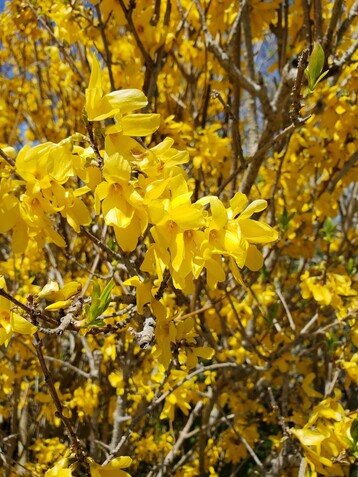
Current Nature: Featuring Forsythias
Seth Engelbourg, Director of Education and Interpretation at the Linda Loring Nature Foundation •
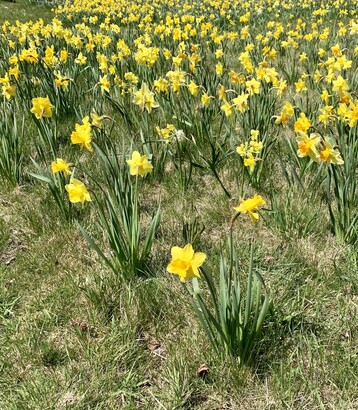
Yellow is the definitive color of April on Nantucket as daffodils bloom and people gather to celebrate. Yet today I am going to highlight another beautiful blooming plant with yellow flowers, Forsythia.
Forsythia is a genus of flowering plants in the olive family. Of the 11 known species, most originate from East Asia; China, Korea, and Japan and none are native to North America. Forsythia became a highly sought after ornamental plant in Western gardens in the mid-1800s, particularly two species: Forsythia suspensa and Forsythia viridissima. The latter was ‘discovered and sourced’ by infamous plant-hunter, Robert Fortune.
Unfortunately, by ‘discovered and sourced’, I really mean it was stolen from China without permission. As an aside, it was not the first time Fortune had stolen plants from China. In 1848, he pulled off what is known as ‘The Great Tea Heist’, smuggling tea plants and skilled workers to India to generate production for the British East India Company. Fortune’s escapades transformed tea from an expensive Chinese-dominated product to a global commodity and are a central reason why tea is available around the world today.
As Forsythia became more common and available throughout Western gardens, additional species were sought by plant-hunters and were further introduced to the Western world. Around the time of World War I, Forsythia became a widespread and popular landscape planting, especially in the Washington, D.C. area.
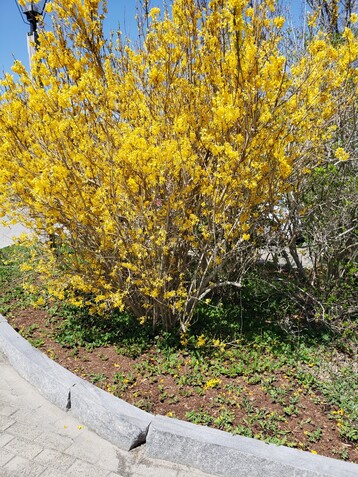
Today on Nantucket, you can find Forsythia blooming across the island, mainly in landscaped gardens. However, some individual plants have escaped from cultivation and can be found growing in minimally managed areas. Although Forsythia is a non-native plant, it is not considered invasive as there is no documented economic, ecological, or public health harm.
Biologically, Forsythia plants flower bloom before they leaf out, so you’ll see the otherwise bare branches covered with bright yellow flowers. The peak of this bloom is often around mid-April, so keep an eye out other the next few weeks. The individual flowers, have a very distinct bell-shaped look, with four petals on each flower; one of the common names for Forsythia suspensa is Golden-Bell.
Beyond their beauty as an ornamental planting, there are some other interesting uses for Forsythia. The yellow flowers are edible, albeit a bit bitter when eaten raw, and are sometimes added to salads. The flowers can also be dried for herbal tea or turned into a syrup. I have made Forsythia Syrup before, the bright yellow color is beautiful, and the taste is very floral and somewhat reminiscent of peaches. As always, remember to practice ethical foraging and ensure that you know exactly what something is before you eat it. Flowering Forsythia branches can also be harvested and turned into a wreath, which to me seems like the perfect opportunity to add some Spring spirit to your front door.
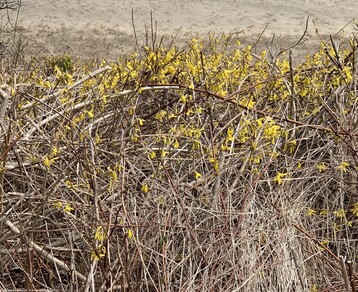
As you go about the island over the next few weeks, keep an eye out for blooming Forsythia. It may brighten your day as you drive past it blooming in people’s gardens, but you may also discover it in unexpected spots!
Stay tuned for more editions of Current Nature, a bi-weekly column featuring seasonal topics, natural history information, and advice on the outdoors from the staff at the Linda Loring Nature Foundation.