Current Nature: Prairie Dogs Of Nantucket
Sarah Bois, PhD Director of Research and Conservation, Linda Loring Nature Foundation •
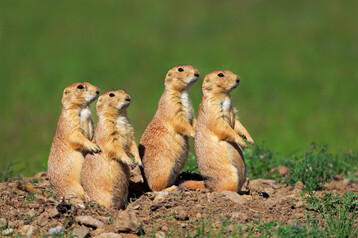
Nantucket has a wealth of biodiversity, but not so much in the way of mammals. So when a new mammal comes to the island, it’s certainly something of note. That is as true today as it was decades and centuries ago. A lot of us know the story of how deer came to Nantucket. And maybe about the raccoon that was tracked around the island. But have you heard about 10 years of Nantucket’s history, where the island was overrun with prairie dogs?
I first became aware of Nantucket’s history with prairie dogs in 2021 while researching mammals of Nantucket (specifically introductions). One line in an article from the Great Plains about a historic population of prairie dogs on the island of Nantucket. I thought it was a joke at first. Squirrels, sure. Raccoons…we’ve had a few. But prairie dogs? They don’t even occur east of Nebraska. That one short sentence led to a deep dive into the history, the politics, the consequences, and the ultimate demise of the prairie dogs of Nantucket.
It all started in 1890 when one or two pairs of prairie dogs were introduced to the island as a game species. At the time, Nantucket was an agrarian community. The open sandplain grasslands and heathlands were reminiscent of the Midwestern prairies, and it seemed like prairie dogs would do well here. These habitats were not regarded with the same reverence that we have for them today. It was put bluntly in the Inquirer in Mirror in 1891 in a Letter to the Editor entitled: A Plea for Game, “…we have little or nothing, but waste lands about the island. What harm can arise from any of these innocent little animals, for they will all confine themselves to the swamps, woods, and waste moors, and, it is firmly believed, without injury to anyone or fear of "disaster."
That’s some serious foreshadowing.
According to “The Prairie Dog of the Great Plains,” published in 1901 and written by C. Hart Merriam, the prairie dogs on-island reproduced slowly at first and were regarded as a novelty. On Nantucket, with few predators, there was a lack of natural enemies and plenty of space. Thus, it’s not surprising that the population exploded within a few years. It’s estimated that the population was somewhere in the thousands at its peak by 1899.
A specimen collected at the time was identified as Cynomys ludovicianus, known today as the black-tailed prairie dog. These Nantucket critters likely came from somewhere on the Great Plains between Kansas and Texas. The preferred habitat for the black-tailed prairie dog is dry, short to mid-grass prairies. Nantucket, with its dry sandplain grasslands, fits this habitat description, if not the historic range.
Currently, black-tailed prairie dogs are found from Nebraska to Montana. Their range used to be much larger, but widespread eradication, primarily by ranchers, has limited their range to mainly protected lands.
Females can breed only once a year. However, one male can impregnate multiple females. They reach breeding maturity by age two (if not before), and females can have three to four pups per litter. This reproductive strategy explains why, on Nantucket, there was a lag phase after first coming to the island. It wasn’t until a few years after the initial introduction that the population became so abundant that it became a visible problem.
Prairie dogs are very social animals. Their colonies, or towns, may contain hundreds of individuals living within a relatively small area. The towns are underground with a complex system of tunnels, nesting chambers, and mounds. The burrows measure an average of five to 10 meters in length (16-32 feet) and two to three meters deep (6.5 to 10 feet). Entrances to the burrows are 10-30 centimeters in diameter (4-12 inches).
Herein lies the demise of prairie dogs on Nantucket. If it weren’t for deep burrows and wide openings to said burrows, our high school mascot may be the prairie dogs instead of the Whalers. In a time when horses were the primary mode of transportation, and livestock (sheep and some cattle) were the main industry of the day, deep holes in fields were a danger. There were no specific reports of animals injured on Nantucket, but that is often cited as a primary danger by ranchers – that livestock will break legs in prairie dog holes.
In the late 1890s, at the peak of the prairie dog infestation, many locals also argued that the prairie dogs were destroying crops and fields. Black-tailed prairie dogs eat primarily leaves, roots, and stems of grasses and forbs. People were “alarmed and feared that the animals would overrun the whole island.”
Calls to the Select Board (then Board of Selectmen) demanded that the Town do something about the prairie dogs. In 1896, Article 50 in the Annual Town Meeting Warrant called for allocation of funds to provide a bounty to help exterminate the “pest” prairie dogs. Money was also allocated to advertise the bounty. They needed to get the word out to Nantucket residents and beyond! At the meeting, a bounty of 10 cents/prairie dog was set, and “some sharp criticisms for the parties introducing them (to the island) were offered.” I would have loved to have been a fly on the wall at those town meetings.
While somewhat successful in culling the population, the bounty didn’t do enough to reduce the problem of prairie dogs.
In a letter to C. Hart Merriam, Outram Bangs detailed his visit to Nantucket in 1899, when he counted 200 visible prairie dogs in one colony. He believed there were three or four colonies of similar size, plus a few smaller colonies, as well as scattered pairs throughout parts of the island.
By 1900, Nantucketers had declared “war” on these introduced mammals. At a town meeting in 1900, the town created a committee whose sole purpose was to investigate ways to exterminate the prairie dogs. A portion of the town budget—$350—was allotted specifically for their control. In an oral history recording available on the Nantucket Historical Association website, Albert Lewis talked about “Old Henry Brown,” a member of the committee of three people. Apparently, Mr. Brown told Lewis that he was “disgusted” by the prairie dogs after working to try to exterminate them for some time. The committee finally decided on a concentrated, island-wide effort. Another $200 was procured for poison, and a plan was hatched. Carbon bisulfide was used to saturate rags, which were then placed in the mouths of all the burrows, and the holes were closed with dirt.
Later that year, it was reported that the original and largest colony at the “Kimball-Hills place” was exterminated. The Prairie Dog Elimination Committee later reported, “It is to the skillful and energetic efforts of Mr. M. Nutt, ably assisted by Mr. Harrison Gardner and son, that this happy result is due.” The team also reported covering the western section of the island and small colonies in other sections, including Monomoy and Nobadeer. They then worked through 'Sconset, Polpis, Squam and other eastern sections. The method was successful, and all prairie dogs were believed to have been exterminated that year. As W.W. Neifert wrote in February 1900, “…now there is not a dog left to tell the tale.”
To this day, no prairie dog has been seen again on-island. Although there was a scare in 1934 when a reporter from the Brooklyn Eagle called Nantucket “Gopher Island,” falsely reporting that the prairie dogs still ruled. The article stated, “The prairie dogs accepted Nantucket as a swell resort, dug holes in a businesslike manner. But now they own Nantucket. Pop in and out of holes right on putting greens of the most exclusive golf courses, disturb temperamental golfers, and create other forms of havoc.” The Nantucket Publicity Committee demanded that the paper retract the statement.