Audit Of Wiggles Way Affordable Apartments Financing Raises Transparency Concerns Over $22 Million Project
JohnCarl McGrady •
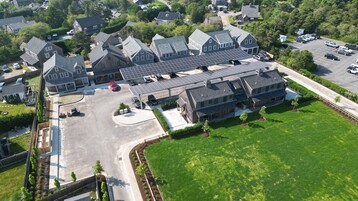
A draft audit of the largely town-funded Wiggle’s Way affordable housing complex raises concerns about the project's transparency and the use of public funds by the initial contractor, Fairgrounds Common.
“[The] agreement [between the town and Fairgrounds Common] defined a limited scope and did not include a detailed pricing breakout, including transparency around the builder’s fee,” the audit reads in part. Because Fairgrounds Common provided limited supporting information, the auditor “was unable to assess the reasonableness of the original contract sum. This limitation was compounded by the absence of detailed pricing support and scope descriptions” for each of the change orders Fairgrounds Common requested as the project’s budget ballooned well beyond what was originally allocated.
Fairgrounds Common and builder Billy Cassidy broke ground on the Wiggles Way apartments project in January of 2022. At the time, the belief was that the development, which consists of 22 apartment units and 38 bedrooms across eight buildings off of Fairgrounds Road, would be complete by the following fall. But the project hit a series of expense overages and delays that cost the town years of time and millions of dollars. The price of the 31 Fairgrounds Road development was initially estimated at $10.3 million in 2021, but the project went over budget six times during construction and ultimately cost closer to $22.2 million, according to the audit, more than double what was first projected. The overages pushed the construction costs to $840 per square foot.
During a meeting of the Affordable Housing Trust on Tuesday, Trust members and other stakeholders criticized elements of the draft audit as inaccurate or incomplete and emphasized the development’s success in providing affordable housing to islanders.
“It's clear to me that more accurate information could have been obtained had [the auditor] broadened the pool of people that they spoke with,” said Affordable Housing Trust vice chair Penny Dey, who served on the construction committee for Wiggle’s Way. “The fact is that we now have neighborhood housing, housing year-round people.”
Wiggle’s Way was one of the first major affordable housing developments on Nantucket that was funded in large part by the town through its Affordable Housing Trust. When the development, a partnership with local non-profit Housing Nantucket, first began in 2021, it represented a major commitment to developing lower-cost workforce housing. In a bid to combat the island’s housing crisis, the town and Housing Nantucket joined forces to purchase the two-acre property at 31 Fairgrounds Road and turn it into a housing complex, with much of the money coming from an allocation approved by voters at Town Meeting two years before.
One of the Wiggles Way cost overages was related to an expansion of the project to include more housing units, and Dey pointed out that even with the expense increases, the final cost was lower per unit than many similar projects on-island. Some of the other cost increases were related to the impacts of the COVID-19 pandemic.
The overages and delays led the town to commission an audit of the project. A draft of that audit, released as part of the Affordable Housing Trust’s agenda packet late last week, returned a series of recommendations and concluded that some of the money paid to Fairgrounds Common was “unsupported.”
Town of Nantucket housing director Kristie Ferrantella told the Current that the town has already implemented some of the audit’s recommendations and will implement many others for similar projects in the future.
“I think the recommendations are very helpful,” Ferrantella said.
Ferrantella emphasized that Nantucket is one of the first communities to build extensive affordable and attainable housing using taxpayer money. The town’s commitment to housing, routinely backed by voters at Town Meeting and the ballot box, has contributed to hundreds of homes being added to the island’s subsidized housing inventory list, many of those after Wiggle’s Way first broke ground. The Fairgrounds Road development, Ferrantella suggested, stands as an early learning experience not just for Nantucket, but for other similar communities struggling with comparable housing crises.
“This was the first major project that was financed and executed in this way,” Select Board vice chair and Affordable Housing Trust member Brooke Mohr added at the Trust’s meeting. “We are already doing things differently with projects that are underway now.”
The draft audit, prepared by CBIZ Risk and Advisory Services, criticizes the “fixed fee” structure used for the Wiggle’s Way project, in which a contractor agrees to a defined scope of work in return for a set payment. CBIZ calls for the town to instead use a “guaranteed maximum price” structure, in which projects cannot exceed a pre-agreed price cap but can come in under budget.
Ferrantella told the Current that the town plans to use a guaranteed maximum price structure for similar projects moving forward.
CBIZ argues that the fixed fee structure “provides limited transparency into how costs were developed or how expenses evolved during the project,” creating a “black box” where the owner does not understand the true cost of the development, cannot accurately validate requests for additional funds, and struggles to resolve disputes. Each of these issues, CBIZ says, was observed during the construction of Wiggle’s Way.
CBIZ claims that a guaranteed maximum price structure, by contrast, is an “open book” in which actual costs are reviewed, savings can benefit both parties, and the owner has more direct oversight of the project’s progress.
If the town continues to use a fixed-fee structure, the audit calls for more detailed, itemized receipts of costs and expenditures, and potentially an interim audit when projects are half-completed.
Near the end of the report, CBIZ outlines concerns with how Fairgrounds Common spent the money it was allocated, concluding that “documentation gaps, tax-exempt billing issues, and limited support for certain invoices under the original fixed-fee arrangement” leave around $60,600 “unsupported or related to sales tax that should not have been paid.”
Ferrantella said that the Affordable Housing Trust is likely to ask the town’s attorneys how to proceed, but that “right now, our focus was completing the audit and reviewing the recommendations with the trust members.”
Cassidy admitted that the sales tax payments “should have been handled differently,” calling it a “legitimate concern,” but added that he struggled to get vendors to accept paperwork showing he did not have to pay sales tax.
CBIZ conceded Tuesday that the draft audit contained errors, including essentially counting a large payment to one contractor twice and then claiming they couldn’t verify half of the payment, a mistake Cassidy called “glaring.”
Eventually, as cost overruns mounted and Cassidy faced health issues, Housing Nantucket and the town changed course, handing the development to local home builders, Stephens and Company.
“I think that things could have been done differently, and, in retrospect, they should have been,” Cassidy said. “But at the end of the day, I am very proud of the end product.”
The audit says that the change to Stephens and Company significantly increased transparency and that all of Stephens and Company’s expenses were reasonable. Once they had control of the project, they did not request any further cost increases.
The vast majority of the cost of the Wiggle’s Way development was borne by the Affordable Housing Trust, though Housing Nantucket also paid several million dollars. A small portion of the project was funded by a $600,000 federal grant from the American Rescue Plan Act. Housing Nantucket functioned as the developer and project manager.
“We appreciate the recommendations that are emerging from the report,” Housing Nantucket executive director Anne Kuszpa said. “Many of them we learned along the way and are already putting in place.”
The audit recommends ensuring that future projects funded by the town’s Affordable Housing Trust use competitive bidding processes, which Ferrantella said is already a mandate for projects that don’t go through an intermediary like Housing Nantucket, and that it would apply to other comparable developments in the future.
“Based on our experience, large construction projects are typically awarded through a Request for Proposal (RFP) or other competitive bidding process,” the audit reads in part. “This is a leading practice for construction contracts involving public funds because it promotes transparency, competition, and value. When an RFP process is not used, the risk of reduced transparency and limited competition increase[s].”
It also calls for a “qualified, independent on-site inspector whose responsibility is to verify on behalf of the owner that the work included in each payment draw has been completed and that it meets the required quality and specifications.”
This, the audit says, could help prevent “overbilling” by contractors for work that has not yet been completed. Ferrantella said this has already been included in agreements signed after Wiggle’s Way.