After Alleged Vandalism, SBPF Submits Plan To Repair Geotubes At Sconset Bluff
JohnCarl McGrady •
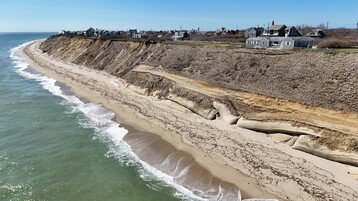
The Sconset Beach Preservation Fund has outlined a repair plan for its damaged geotube installation along the Sconset Bluff, the first concrete indication since the geotubes were allegedly vandalized last January of how the non-profit plans to address the partially collapsed erosion-control project.
Sconset Beach Preservation Fund (SBPF) representative Meridith Moldenhauer told the Current that, while SBPF does not yet have a firm grasp on the timeline, it expects that it will cost around $1.8 to $2 million to repair the damage stemming from the alleged vandalism.
That is, if the plan is ever implemented. A major expansion of the geotubes, advanced by SBPF and the town, was narrowly defeated at Town Meeting last month, leaving the future of the array uncertain. Moldenhauer told the Current that “the existing project in and of itself is not sustainable, and in order to preserve what is there now and protect the entire area that is at risk…the expanded project is the only way forward.”
SBPF has “not contemplated” whether it would repair the geotubes without word that the town plans to continue pursuing an expansion of the array, but Moldenhauer called the idea “not practical.”
Long textile fabric rolls filled with a slurry of sand and water and installed at the base of the bluff to protect the homes perched along Baxter Road above, the geotubes have been a source of controversy since before they were even installed. In late January, images and videos surfaced showing straight, clean cuts along a portion of the geotube installation, which caused it to collapse onto the beach below. SBPF immediately dubbed the cuts vandalism, calling the police and offering a $10,000 reward for information leading to the arrest of a suspect responsible for the damage.
So far, no suspects have been identified, and the condition of the geotubes has continued to deteriorate. In March, after a natural secondary collapse along the same portion of the installation, the chair of the Conservation Commission, the local regulatory board tasked with permitting coastal engineering structures like the geotubes, said the installation was nearing “complete failure.” Since then, SBPF has worked on a plan to repair the damage.
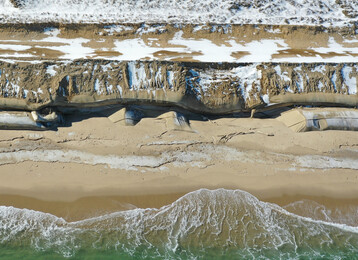
The plan was supposed to be filed with the Conservation Commission last month, and the delay provoked some sharply worded criticisms from commissioners and Natural Resources Department staff, who called it “wholly unacceptable” and “disappointing.” In a letter sent to the SBPF, conservation agent Will Del’Erba called SBPF “delinquent,” slamming them for the delays and the allegedly short notice on which those delays were communicated to the Commission.
In a response to the Conservation Commission, SBPF attorney Richard Nylen wrote that SBPF “respectfully disagrees with the characterisation that it has been delinquent or nonresponsive in providing requested materials,” claiming that “delays have been driven by several factors outside of SBPF's direct control, including the scheduling and coordination of coastal engineers and surveyors, the need to incorporate field conditions as they evolve, and the iterative review required to ensure that submissions are accurate and appropriate.”
The dueling letters represent the latest clash between the Conservation Commission and SBPF, two entities that have had a tumultuous relationship for well over a decade, spanning several project approvals and sometimes heated criticism, including an order to remove the erosion control project from the bluff entirely.
The repair plan, developed by local contractor Cottage and Castle, calls for the removal of the damaged geotubes and any associated sand, followed by the installation of new geotubes. The new tubes will be installed using the same protocols as the original tubes.
“This plan reflects coordination with qualified professionals and is intended to provide the best path forward for all,” Nylen wrote.
D Anne Atherton, director of the Nantucket Coastal Conservancy, a local advocacy group long opposed to the geotubes, expressed frustration with the repair plan.
“It doesn’t make sense to me to repair a sea wall that [the Conservation Commission] ordered removed five years ago,” she told the Current. “My sense is that the geotubes have run their course.”
The plan is somewhat sparse on details, which could be due to ongoing uncertainty about how to proceed. The town of Nantucket remains a major unknown, as it has yet to indicate where it stands on potential next steps.

“The Town's position will impact whether removal [of the geotube installation] is necessary, whether a license to conduct major rebuild and repairs of the vandalized geotube requires Town Meeting approval, and the proposed timing for proceeding forward,” Nylen wrote in his letter to the Conservation Commission. “Realistically, it will take time to resolve the regulatory, license, and practical timing issues involved in creating a mutually agreed path to go forward.”
Atherton also referred to the town’s role in the future of the project.
“We’re all looking for the town leadership to bring us together,” she said.
The removal of the damaged geotubes carries a certain irony. In 2021, the Conservation Commission ordered the removal of the geotubes, an order later upheld by a Superior Court judge. But SBPF simply refused to follow the order, arguing that doing so would endanger a pair of homes perched on the bluff. In the meantime, the Select Board reshuffled the membership of the Conservation Commission, which eventually agreed to an expansion of the geotube project, largely dropping calls for its removal.
Now, years later, SBPF actually is going to at least temporarily remove a portion of the installation—including a section directly in front of 93 and 97 Baxter Road, the two houses it previously warned could collapse into the water should the geotubes be taken out of the bluff. Unlike what was contemplated in the Conservation Commission’s removal order, however, new geotubes will be quickly installed.
Moldenhauer also said that additional precautions will be taken to protect the homes most at risk.
The plan says that the geotubes will then be “covered with compatible sand base,” a long-standing flashpoint in debates over the erosion-control project. As a condition of its permit, SBPF is required to cover the erosion-control project with large amounts of sacrificial sand, which is dragged away by the waves and deposited farther down the coast. This sand takes the place of naturally occurring beach sand, guaranteeing that the ocean will have sediment to cough up downdrift of the coastal resilience structure. Without this sacrificial sand, the geotubes could prevent erosion in one location at the expense of greater erosion in another.
The Conservation Commission and local advocacy groups like the Nantucket Coastal Conservancy have long argued that SBPF has endangered the shoreline downdrift by shirking this responsibility and providing insufficient sacrificial sand. SBPF has countered by claiming that the permit calls for more sand than is necessary, and that the installation must be expanded before upkeep can become financially viable.
Critics of SBPF have also raised concerns about the source of the sacrificial sand and the narrowing of the beach at the toe of the bluff. SBPF has dismissed these concerns and argues that the erosion control project has successfully protected the homes on Baxter Road at no cost to taxpayers, avoiding the need for a costly relocation plan and providing a strong example of how future coastal resilience structures on island can work.
SBPF’s latest filings also include an updated topographic survey from March of 2026, which shows that erosion has continued along portions of the bluff but claims that sufficient walkable beach remains at the foot of the bluff to meet minimum licensing criteria.
Covering the geotubes with sand, as mandated in SBPF’s permits, could also help deter vandalism. Dell’Erba has previously suggested that the vandalism might not have been possible if SBPF had been in compliance with its permits.
The alleged vandalism is hardly the extent of SBPF’s problems. The major expansion of the geotubes was narrowly defeated on a 182-163 vote at Town Meeting last month. With that defeat, SBPF can’t proceed with the 3,000-foot expansion, even if it cleared all its remaining legal hurdles and received state approval.
“SBPF recognizes that, following the recent Town Meeting vote denying authorization for the extended geotube configuration licensing, broader questions remain regarding the future of the project. Those questions involve legal, logistical, and financial considerations,” Nylen wrote.
The town and SBPF, which partnered on the planned expansion, have both been hesitant to comment on its future to the Current. Apparently, the town was also hesitant to show its hand to Nylen, who wrote that he reached out to the town but did not receive a clear answer, adding that “at this juncture, it will be helpful to obtain clarity as to whether the Town seeks to pursue further Town Meeting authorization, consider modification or continuation of the project, [recommend] removal of the existing project, or proceed in another direction.”
One option would be to try again at Town Meeting next year, perhaps with some slight tweaks to the plan. Three town-sponsored projects that voters rejected last year were back on the warrant this year with small changes, and all three passed.
Another option would be to abandon the geotubes entirely and focus on an alternative access plan that the town has been developing.
The alternative access plan, which was recently approved by the Conservation Commission, lays out a strategy to provide roadway access and essential utilities to the homes on Baxter Road should erosion render it impassable. It is a costly option, though, and cannot be implemented immediately.
Implementation could prove even more difficult if homeowners in the area fight back against the plan. A deal reached between the town and SBPF for the expansion of the project would have mandated SBPF to obtain assent to the alternative access plan from those homeowners.
Some leading voices on the issue, including members of the Nantucket Coastal Conservancy and the Select Board, have called for a renewed open dialogue between stakeholders in the wake of the Town Meeting defeat.
“We have always been open to conversations and dialogue,” Moldenhauer told the Current. “It has mostly been the opposition who have been adamant against the project and have not been open to engaging in conversations.”
With all parties seemingly open to discussions, it remains to be seen if talks will be held on the future of the project or if the removal plan presented to the Conservation Commission will ever go forward.