Voters Reject License For Expansion of Sconset Bluff Geotube Erosion-Control Project
JohnCarl McGrady •
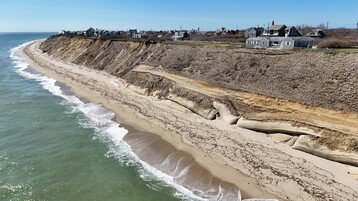
Town Meeting has blocked a proposed expansion of the controversial geotube erosion control project along the Sconset Bluff on a 182-163 vote.
The vote represents a major defeat for the town and its partner, the Sconset Beach Preservation Fund (SBPF), in their battle to extend the geotubes down the bluff. While the Select Board endorsed the proposal and signed off on an agreement with the Sconset Beach Preservation Fund that included around $9 million in contingency funds, it wasn’t enough to overcome the skepticism and distrust of local voters.
"You have to vote no tonight in order to maintain your ability to speak on how our beaches are used in Sconset," former Select Board member Rick Atherton said. "They're our beaches."
Without support from Town Meeting, the 3,000-foot expansion can’t go forward, even if remaining legal challenges are cleared, and the state signs off on the project.
For decades, SBPF has battled local activist groups and regulatory bodies over the geotubes, long textile fabric rolls filled with a slurry of sand and water and installed at the base of the bluff to protect the homes perched along Baxter Road above. The Select Board agreed to a partnership with SBPF to expand the geotubes with private funds from the non-profit to also protect the town's infrastructure and access to Baxter Road properties, including the Sankaty Head Lighthouse.
But opponents have raised concerns about the impacts of the geotubes on nearby beaches and fish populations, and the source of the mitigation sand SBPF is required to pour over the tubes to ensure that those beaches are not eroded—a requirement SBPF has often shirked.

"There is still entirely too much missing information to determine whether or not the project can even be fully permitted or legally built, let alone to determine how extensive the negative impacts may be," Nantucket Land and Water Council executive director Emily Molden said. The Nantucket Land and Water Council is one of several local advocacy groups, alongside the Nantucket Coastal Conservancy, that have staunchly opposed the geotubes. "The town's co-applicant has failed time and time again to comply with their commitments, license conditions, and with past permit requirements, so unfortunately, we have very little reason to believe that they will do so in the future. We hope you'll vote no."
The last article voters weighed in on at Town Meeting, Article 73 would have authorized the town to enter into a license agreement with SBPF for the use of the land at the foot of the bluff. The license would have required SBPF to fund the expansion of the geotubes, gain assent from all impacted property owners for a potential future removal plan, create additional stairs providing public access to the beach below the bluff, and supply around $9 million in contingency funds for potential costs stemming from the project.
Town representatives have hammered home the importance of the contingency funds, emphasizing that the $9 million provides the town with robust insurance should SBPF renege on the deal.
"These are cash reserves immediately available to the town if needed. Our financial risk is fully covered, and control remains with the town," town sustainability programs manager Vince Murphy said. "Island-wide, this project can be a model for property owners to pay for coastal resillience into the future and reduce the taxpayers cost."
In the past, SBPF has repeatedly ignored the terms of its agreements with town bodies. At one point, the Conservation Commission, tasked with permitting all such projects on island, even mandated that SBPF remove the geotubes entirely, and SBPF ignored the order. This history resurfaced on Town Meeting floor.
"The town's partner, SBPF, has a long track record of violating the terms of their permit and ignoring successive enforcement orders," Nantucket Coastal Conservancy director and former Conservation Commission member Maureen Phillips said. Phillips said that she spoke on behalf of five former members of the Conservation Commission: Ashley Erisman, Ian Golding, Sarah Oktay, Mark Beale, and herself.
"We ask you to please vote no on 73," Phillips said. "Let's not allow the Select Board and their partner to circumvent the science and the law."
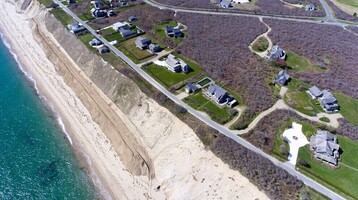
Arguments that the expansion, which would have come at no cost to Nantucket’s taxpayers, is needed to protect Baxter Road and avoid the potentially enormous cost of providing utilities to homes along the bluff should the road be deemed impassible, were unable to sway enough voters to ensure the passage of the article, leaving the town to find a different path forward for Baxter Road.
"Alternative access, those things are not ready yet. We need to get those in place," Select Board member Matt Fee said. "What we need to is what we've been really trying to do, is find the middle, find a path forward that's going to work for the town and for the island."
One such path could be the alternative access plan recently approved by the Conservation Commission. Town leaders emphasized Tuesday that the plan is costly and cannot be implemented immediately, but if erosion makes the road unsafe, it could be the town’s only available response. The draft license would have SBPF to gain assent for the plan from impacted homeowners.
But some voters did find the arguments in favor of the geotubes convincing. The vote was the closest of the night.
"We are asking that you allow us, as individual homeowners and private citizens, to fund, construct, and maintain the project at no cost to you, the taxpayer, rather than allowing erosion to take its course with no plan and unforeseen risks," SBPF representative Meridith Moldenhauer said. "A yes vote tonight on Article 73 is a vote for stewardship and a vote for resilience."
It also drew some broader media attention: The Wall Street Journal attended Town Meeting to cover the debate.