License Agreement For Expansion Of Geotubes Along The Sconset Bluff Approved By Select Board
JohnCarl McGrady •
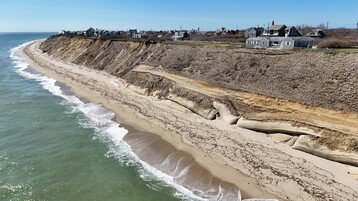
The Select Board has unanimously endorsed a draft license agreement with the Sconset Beach Preservation Fund (SBPF), a major step toward enabling the proposed expansion of the controversial erosion-control geotube installation along the Sconset Bluff. But voters will have the final say on whether the project can proceed.
“This may not be a forever solution, but it's something that really needs to happen now with the extent of the erosion,” chair Dawn Hill said.
The draft, which can still be modified after Town Meeting votes on whether to authorize the expansion next month, is similar to one considered by the Select Board on April 2nd, but with several changes made to tighten requirements on SBPF.
The latest in a series of deals between the town and SBPF, the license agreement would require SBPF to fund the expansion of the coastal hard-armoring structure, gain assent from all impacted property owners for a potential future removal plan, and create additional stairs providing public access to the beach below the bluff.
In part, the changes require mandated contingency funding from SBPF to be submitted before construction begins, create a new contingency fund for road damage, and ensure that all legal appeals are settled and that SBPF provides the documents needed for a proposed alternative access plan for the area to go forward before any work can start.
The geotubes, long textile fabric rolls filled with a slurry of sand and water and installed at the base of the bluff to protect the homes perched along Baxter Road above, have been deeply controversial even before they were installed in 2014 after a series of storms ripped away large chunks of the beach, threatening to breach Baxter Road, which runs along the Bluff to the Sankaty Head Lighthouse. One major cause of controversy is SBPF’s long history of reneging on deals and failing to comply with permit requirements. At one point, the Conservation Commission even mandated that SBPF remove the geotubes entirely, and SBPF ignored the order.
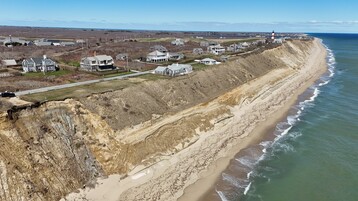
Town representatives argue that the contingency funds required of SBPF, which total around $9 million, will keep them from breaching the terms of the latest agreement.
“We can trust or not because we have a document that...has a lot of teeth to it,” Select Board vice chair Matt Fee said.
Sustainability programs manager Vince Murphy has said that if SBPF breaks the terms of the agreement or dissolves as an entity, the geotubes would be taken out of the bluff.
The proposed 3,000-foot expansion, which was approved by the Conservation Commission, would protect a number of homes that the current installation does not reach.
SBPF’s history of violating agreements with town bodies is not the only reason for the opposition the project has faced since it was first proposed. Opponents, including local advocacy groups the Nantucket Coastal Conservancy and the Nantucket Land and Water Council, have raised broader concerns about the impacts of hard-armoring the bluff on nearby beaches and the source of the mitigation sand SBPF is required to pour over the tubes to ensure that those beaches are not eroded—a requirement SBPF has often shirked.
SBPF argues the impacts are far smaller than alleged, and the project is needed to protect the homes of property owners in the area and as a test case for how to guard the rest of the island against erosion as sea levels continue to rise.
Some town leaders see the project as a pragmatic necessity, avoiding the potentially enormous cost of providing utilities to homes along the bluff should Baxter Road be deemed impassible.
“This board has pretty consistently understood the need to do erosion control on the bluff because there are risks, serious financial risks, to the community in terms of our requirement to provide utilities to the properties,” Select Board member Brooke Mohr said. “I do think this license agreement is good, I think it's got a lot more accountability, it's got a lot more enforceability.”
While he ultimately voted in favor of the draft, Select Board member Malcolm MacNab, who has often voiced criticisms of the proposed expansion, once again expressed his doubts.
“I'm still skeptical. I just don't see this project as being successful in the long run. I'm not comfortable with it. I think at some point we're going to have to say: 'No. Everyone did a good job, everyone was open, but it's time to stop’,” MacNab said. “At some point, you're all going to have to say enough is enough.”
The Select Board’s endorsement of the draft license does not guarantee that the expansion will go forward. For that to happen, Town Meeting would have to vote in favor of the project, the state would have to issue required permits, and ongoing legal disputes over the legality of the work would have to be resolved.
Meanwhile, the existing geotubes are facing difficulties of their own. A portion of the geotube installation collapsed last December after sections ripped open in what SBPF described as an act of vandalism. This led to a second, natural failure on another level of the geotube installation. It’s unclear if the damage can be repaired or how it might affect the expansion, but it does not appear that investigators are any closer to identifying any potential culprits, despite a $10,000 reward offered for any information leading to the identification of the suspects.
The project has recently drawn renewed regional and national attention, with the Boston Globe editorial staff calling for the state to step in and the Wall Street Journal covering the vandalism.
The town is also working on an alternative plan to allow access to homes along the bluff should erosion render Baxter Road impassable. That plan was just approved by the Conservation Commission, and the draft license agreement requires SBPF to gain assent from the property owners affected by the alternative access plan for a betterments system that would enable the town to levy a special tax on them to fund alternative access.