Escrow Funding, Sand Sourcing Debated As Select Board Considers New License For SBPF
JohnCarl McGrady •
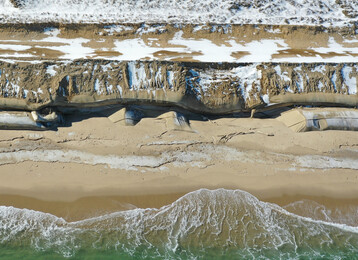
The Nantucket Select Board has continued a discussion on a new license agreement with the Sconset Beach Preservation Fund, which is needed for the proposed expansion of the controversial erosion-control geotube installation along the Sconset Bluff, to allow town representatives to make changes to the language.
The latest in a series of deals between the town and SBPF, the license agreement would require SBPF to fund the expansion of the coastal hard-armoring structure, gain assent from all impacted property owners for a potential future removal plan, and create additional stairs providing public access to the beach below the bluff.
SBPF has reneged on many of its previous commitments, a point raised by several commenters at Wednesday’s hearing. At one point, the Conservation Commission even mandated that SBPF remove the geotubes entirely, and SBPF ignored the order. This has led some to worry that history may repeat itself if the Select Board approves the license agreement.
But sustainability programs manager Vince Murphy believes this time will be different, in part because the town has required around $8.5 million in collateral from SBPF, intended to be enough to cover the cost of one year of maintenance on the geotubes and their subsequent removal. Murphy was clear that if SBPF breaks the terms of the agreement or dissolves as an entity, the geotubes would be taken out of the bluff.
“If they fold, if they go away, if they do anything wrong, there's essentially one outcome, where geotubes get removed,” Murphy said, referring to the possibility as a “Sword of Damocles” hanging over the head of SBPF.
SBPF representative Meridith Moldenhauer agreed that things would change.
“The whole idea here is to work collaboratively together to preserve and protect the area for as long as possible,” she said. “Yes, there have been a lot of hurdles and challenges. These are really hard issues, and I think that we have worked to resolve those.”
The Select Board opted to wait on voting to approve the agreement so that changes could be made to the language to require that collateral funds be received before construction begins, mandate an annual review before the Select Board, and add an additional escrow fund for potential roadway improvements necessitated by the large number of trucks used to bring sand to the bluff.
“It just occurs to me, having cash in the bank so we can do it in case they don't, seems worth pursuing,” Mohr said of the third proposed change to the agreement.
While most Select Board members seemed amenable to passing the revised version of the agreement, which could mean it is likely to be adopted at the board’s next meeting, one member of the board struck a different tone.
“I'm still uncomfortable about the long-term effects of what we will ultimately be responsible for,” Malcolm MacNab said. “To me, there's just too many unknowns, too many questions, too many promises.”
MacNab, who will leave the board when his term expires after the upcoming May elections, has been the board member most critical of SBPF and the proposed expansion.
The element of the agreement that drew the most pushback on Wednesday was the plan to provide sacrificial sand to the bluff. To mitigate the effect of the geotubes on beaches to either side, sand has to be poured over the installation so that the waves have something to carry with them and deposit downdrift. Otherwise, erosion will be significantly exacerbated on nearby beaches. Historically, SBPF has failed to meet the requirements of its existing permits requiring it to deposit certain amounts of sand on the geotubes.
To obtain the sand, SBPF will have to transport it from the mainland or dredge for it at sea. According to a presentation given by SBPF last year, soon before the Conservation Commission approved the expansion, they plan to begin by using terrestrial sources before eventually securing approval to dredge up sand from the sea floor. Either option is controversial.

If they obtain the sand from the mainland, it will have to be barged to the island and driven to the bluff in dump trucks, contributing to traffic and disturbing residents. The Nantucket Coastal Conservancy, a local beach advocacy group long opposed to the geotubes, estimates it will take around 14,000 trips to bring all of the sand to the bluff, though Murphy said that would represent an increase of less than one percent in traffic.
If SBPF instead sources sand from the sea floor, they’ll run up against opposition from individuals worried about the impact on sea life and fishing.
“I would just ask the Select Board to make sure you get input from the fishing community, because I really feel like this is going to…be a non-starter for a percentage of the island,” Nantucket Coastal Conservancy board president Burton Balkind said.
Murphy replied that SBPF was looking to dredge in federal waters, far from Nantucket’s shores. Select Board member Matt Fee also argued that obtaining permission to mine sand at an offshore site would benefit the town, as that site could then be used for other local projects that require sand, including the many upcoming projects that could be necessitated by sea-level rise and climate change.
“This could be, potentially, a huge benefit for the town,” Fee said. “As a community, we're going to need more sand than we can imagine.”
The Select Board’s approval of the license agreement is a key step in the process to expand the geotube installation, but it does not guarantee an expansion. The project still needs state permits, and on a local level, it requires the endorsement of Town Meeting. The Select Board had previously indicated that, without a license agreement, it would not support the warrant article asking voters to back the expansion.
Attempts to gain support for an expansion may be complicated by the difficulties facing the existing array. A portion of the geotube installation collapsed last December in what SBPF described as an instance of vandalism. This led to a second, natural failure on another level of the geotube installation. It’s unclear if the damage can be repaired or how much a repair would cost.
Meanwhile, the town is also proceeding along another track, pursuing a plan to provide alternative access to the homes along the bluff. That plan was just approved by the Conservation Commission.
The new license agreement would mandate SBPF to gain assent from the property owners affected by the alternative access plan for a betterments system that would enable the town to levy a special tax on them to fund alternative access.