Land Bank Plan For A New Boardwalk Along The Creeks Approved By Conservation Commission
JohnCarl McGrady •
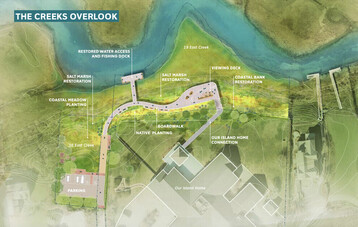
The Conservation Commission on Thursday approved the Nantucket Land Bank’s plan to install a boardwalk along its property overlooking The Creeks behind the current Our Island Home facility.
The plan, first unveiled two years ago, reimagines the Land Bank’s East Creek Road property that it acquired four years ago. It will involve demolishing an existing dwelling and installing a boardwalk with viewing platforms and a dock accessible to recreational boaters.
“Improvements are intended to enhance passive recreation and public access while avoiding and minimizing impacts to coastal resources to the maximum extent practicable,” the Land Bank’s application reads in part. “The intent of the project is to repurpose the existing unoccupied single-family dwelling and pier off East Creek Road in Nantucket to a publicly accessible overlook boardwalk with various recreational opportunities.”
The Conservation Commission approved the plan unanimously, finding that it provided a “significant public benefit.”
Its approval was contingent on a number of standard conditions, erosion and sediment control plans, and public access.
The project also includes grading, reorganization of parking spaces, the removal of invasive species, and the planting of native species. It will be compliant with the Americans with Disabilities Act.
“The Nantucket Islands Land Bank developed the proposed project in response to longstanding goals to improve public access to the coast and provide passive recreational opportunities on publicly owned land along East Creek,” the application continues. “The site has been identified as a suitable location for a small-scale overlook and access improvement due to its proximity to existing public parcels, its relationship to East Creek, and the opportunity to formalize access in a manner that protects surrounding coastal and wetland resources.”
While the Conservation Commission’s approval is a key step in the permitting process, it isn’t the end of the road for the Land Bank, which estimated last summer that permitting could take two years.
The project, which was initially expected to cost around $4.35 million, now has a projected pricetag of $4.94 million, before factoring in $938,000 in permitting costs. The high cost of the permitting and the sprawling nature of the project have divided the Land Bank Commission. While they voted to proceed with permitting for the entire extent of the project, the commissioners are unsure how much of the project should actually be implemented. They are considering around $1.72 million in potential cuts.
The Land Bank purchased the property for $4.8 million in 2022. The project planned for the site is now expected to cost more than the property itself.
The Land Bank is in the midst of a series of development projects across its many properties as its focus expands beyond open space conservation. Some of those projects, including a proposal to construct a floating pier at Petrel Landing, have prompted lawsuits.
Petrel Landing and The Creeks overlook project both involve water-based outdoor recreation, but some of the Land Bank’s other projects, including a new food security hub on Boynton Lane, branch out further. The Land Bank is also moving structures off of its property at 41 Jefferson Avenue to a new location, where it will serve as attainable housing for year-round residents.
Many of these projects come with hefty price tags, sometimes far in excess of the cost of the Creeks Overlook development. The Land Bank derives its revenue from the 2 percent transfer tax on most island real estate transactions that was established in its enabling legislation approved by the state in 1983. Since then, it has acquired more than 3,400 acres on Nantucket and, along with the island’s other private conservation organizations, protected more than 60 percent of the island from further development.
The success of the Land Bank in protecting open space is part of what has motivated the push for the organization to find alternative ways to spend its money, especially as the cost of housing on-island continues to increase, leaving locals paying ever-higher prices for the remaining buildable land not protected by Nantucket’s conservation organizations.