After Additional Collapses, Geotubes At Sconset Bluff Approaching "Complete Failure"
JohnCarl McGrady •
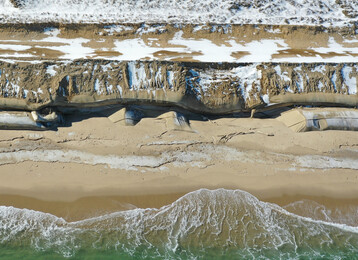
The geotube erosion control project along the Sconset bluff may be approaching “complete failure,” according to Conservation Commission chair Seth Engelbourg. During the Conservation Commission’s Thursday meeting, Sconset Beach Preservation Fund (SBPF) representative Meridith Moldenhauer told the Commission that an additional portion of the installation had collapsed and shared photos showing large chunks of the geotubes stripped of sand and exposed to the elements.
“We're probably moving towards the level where it could be considered almost a complete failure at this point, or at least over 50 percent,” Engelbourg said. “I don't even know if the geotubes could be rebuilt in the area where they are now.”
In late January, photos and videos emerged showing part of the erosion control project deflated and sagging toward the beach below. SBPF claims that this damage was caused by vandalism, and has shared photos that show straight, clean cuts along the geotextile fabric. A review by the geotube manufacturer concurred with SBPF’s claims.
Now, there has been a secondary failure, and SBPF believes that this failure was natural. A portion of the geotube installation in the tier above the tubes that were initially damaged has burst.
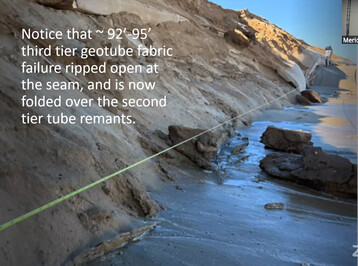
“The upper tier, the third tier, collapsed from the pressure of not having the structural stability of the second tier that had been cut underneath it,” Moldenhauer said. “There are now areas that have both the third tier and the second tier that have ruptured.”
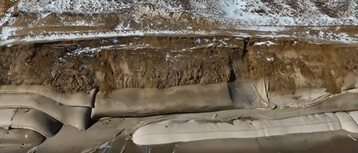
Moldenhauer suggested that the additional failure occurred on the night of February 2nd, but it does not appear to have been reported publicly until today. Moldenhauer added that, during the secondary collapse, the geotubes on the third tier burst “very differently” along the seams than what was seen in the first incident.
Winter storm Hernando, which lashed the island with harsh winds topping 80 mph last week, has only exacerbated the problem, clearing sand from the geotubes and pushing the project even further out of compliance with its permits.
“It's pretty nasty,” conservation agent Will Dell’Erba said. “There’s several areas where the top layer of sand on the template has caved in.”
It’s the latest blow for the embattled coastal resilience structure, an innovative attempt to hard-armor Nantucket’s shoreline that has been deeply controversial since it was proposed as an emergency measure to protect Baxter Road, which runs atop the bluff above the geotubes.
The geotubes, long fabric bags filled with a slurry of water and sand, have drawn strident opposition for over a decade. Supporters argue that the project has successfully forestalled the need for a costly plan to relocate Baxter Road, and has preserved access for homeowners along the bluff, but opponents allege that it has led to significant erosion on the beaches to either side, in part because SBPF has consistently failed to meet the requirements of its permits.
The project has been out of compliance for some time, and at one point, the Conservation Commission actually ordered its removal. SBPF’s past failures to deposit the required mitigation sand on the array may raise concerns that any enforcement order issued by the Commission will go unheeded, a common problem for Nantucket’s regulatory bodies. And Dell’Erba suggested that the lack of mitigation sand could have contributed to the first collapse, even if it was the result of vandalism.
“They have been told to cover them with sand before,” Dell’Erba said. “I feel that at some point, somebody has to say that if they were covered in sand, this might not have been possible to happen.”
Dell’Erba’s statement is the most any town employee has said about the project since the first collapse was reported. While a police investigation into SBPF’s allegations of vandalism continues, town staff across several departments have remained silent, even when asked whether there is an imminent threat to Baxter Road and the homes perched along it.
The town is partnering with SBPF on a proposed expansion of the erosion control project, which may be one reason for their silence. But with evidence mounting that the installation has been seriously damaged, concerns about the road's safety will likely grow.
No repair work can be done legally without Conservation Commission approval, and Engelbourg initially said that the Commission should issue an enforcement order to both allow and mandate the needed work, despite the ongoing police investigation.
“The project as permitted is out of compliance and has been out of compliance for a long time,” he said. “I understand that there are reports of vandalism and whatever else have you, but at the end of the day, our job is the same.”
After seeing Moldenhauer’s photos, however, he suggested that a traditional enforcement order might not be sufficient. The amount of work needed might require an emergency permit, if it can be done at all, and the Conservation Commission isn’t authorized to declare an emergency. Other town personnel, such as the building commissioner—or, in theory, the state—would have to make that decision, which would force the town to break its silence.
“Those pictures are rough,” Engelbourg said. “Given the size and scope of the project, [an enforcement order] might not be in our best interest.”
The expansion of the geotube installation faces a difficult path to approval. It will need the support of voters at Town Meeting this spring, which could be complicated by the ongoing collapse of the existing structure, pending legal appeals challenging the expansion, and at least one highly critical state report.
While another state agency gave the expansion a more favorable review, allowing it to dodge an environmental review process that can take over a year, the state’s final ruling remains unclear.
Meanwhile, SBPF is offering a $10,000 reward for information leading to the arrest of a vandalism suspect, and is working with former Boston police commissioner Ed Davis to conduct a private investigation of the collapse. Davis will also work with local police.
The project will next be discussed at the Conservation Commission’s regularly scheduled meeting in two weeks, though it’s likely that full plans for potential remediation work won’t be ready by then.