After Expansion Proposal Rejected At Town Meeting, What's Next For The Geotubes At The Sconset Bluff?
JohnCarl McGrady •
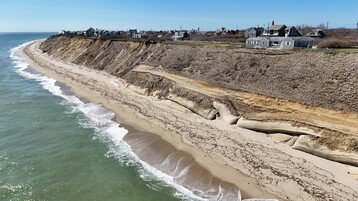
Town Meeting voters earlier this month narrowly defeated an effort to expand the controversial erosion control geotube project along the Sconset Bluff. So what comes next for the coastal resiliency project?
At the moment, the future of the installation—and the 3,000-foot expansion that voters rejected on a 182-163 vote at the end of Town Meeting—is murky. Town representatives said it was too early to comment, and the Current was not able to connect with representatives of the Sconset Beach Preservation Fund (SBPF), which was the town’s partner in the expansion.
What happens next will be determined by a series of conversations over the next several months, some in public and some behind closed doors, as town leaders, Sconset homeowners, and even state environmental agencies and court judges, chart a course for the mitigation structure.
The town of Nantucket, one of two partners on the expansion, has had some success bringing projects back to Town Meeting after they have been defeated. This year, three projects that Town Meeting voted down last spring were back on the warrant, and all three passed. Two of the three projects were barely changed from one year to the next, but a different funding source in one case and an increased sense of urgency in the other were enough to get them over the finish line.
The town could try the same tactic with the geotube expansion, banking on a shifting electorate and perhaps a couple of key revisions to the plan to flip the votes necessary to gain Town Meeting approval. With another year to hash out the specifics of the license agreement for the use of the beach at the foot of the bluff, it's possible the town could attempt to craft a deal capable of winning majority support. But so far, town officials haven’t made any decisions about whether to bring the project back.
“It is too early to determine what may be brought forward at a future Town Meeting,” Town of Nantucket communications director Florencia Rullo told the Current. “The Town will continue to evaluate all available options for protection, adaptation, or relocation in the Baxter Road area.”
Opponents of the expansion were clearer on their perspective.
“I would be disappointed if they did that without having a more open discussion about the longer-term possibilities of the bluff,” said Rick Atherton, a former Select Board member and critic of the geotubes.
Even if the town could gain the support of a majority of voters at Town Meeting, it would still need state approval, which it has not yet obtained. Legal challenges also remain pending. The license agreement voters defeated this spring required that those challenges be resolved before work could begin.
“People need to wait a little bit to see what the [Department of Environmental Protection] is going to do,” Atherton said. “We have to find the answers before we jump to conclusions.”
Another path forward could be to abandon the geotubes entirely and focus instead on the alternative access plan recently approved by the Conservation Commission. Town leaders have emphasized that the plan is costly and cannot be implemented immediately, but if erosion makes the road unsafe, it could be the town’s only available response. The draft license would have required SBPF to obtain assent to the plan from affected homeowners.
The Conservation Commission could also play a role. The existing geotubes are out of compliance with their permit, in part due to an alleged act of vandalism in which one of the geotubes appears to have been slashed.
During a recent Conservation Commission meeting, chair Seth Engelbourg suggested that the expansion project’s failure at Town meeting might force the Commission to order the geotubes removed from the Bluff. A similar order was ignored in the past.
“We have an existing structure that is severely degraded, that has been out of compliance for ten years now,” Engelbourg said. “We basically have a very bad situation on our hands…at some point, we’re going to have to go back to the plan that was before, which is enforcing the removal order.”
The Conservation Commission also expressed frustration with a brief letter from SBPF, in which SBPF representatives failed to provide any information about how the vandalism could be remediated, despite promising the Commission that the information would be ready for its most recent meeting.
“We just have a damaged system that is on the beach. It is not in compliance, it is unmitigated, it is causing a significant amount of environmental concerns,” Engelbourg said. “They have a consultant on staff working with them. They did the survey work already, I think. They just need to get us the information…we demand this plan by June 18th.”
Noting a pattern of delay tactics from SBPF, Conservation Commission members suggested taking a more hard-line approach, warning of consequences if SBPF continued to dodge deadlines.
“We are entitled to this information; you are required to provide this information. Your response this time was wholly unacceptable and fell short of what we’re asking for,” Conservation Commission member Linda Williams said. “[If the information is not provided] other measures may have to be undertaken.”
Town staff concurred.
“I was taken aback a bit by this letter. I found it to be a little disappointing,” conservation agent Will Dell’Erba said. “We need to use much stronger language going forward.”
Williams also raised another possible resolution to the conflict: transferring the beach at the foot of the Bluff from the town of Nantucket to the county of Nantucket.
“There’s a way around it,” she said. “They just transfer the property to the county, and the county doesn’t have to ask Town Meeting anything. There you go.”
Atherton suggested that key stakeholders, including representatives of the town, SBPF, and the prominent anti-geotube advocacy group, the Nantucket Coastal Conservancy, should meet and work together to develop a long-term vision for the bluff that all parties could agree to.
Select Board member Jill Vieth echoed that sentiment.
“I believe the path forward is for stakeholders to come back to the table and work together toward a practical solution,” she wrote in a statement to the Current during her campaign. “We need less division and more alignment. There are clearly strong opinions on all sides, but this issue is too important for the community to remain at a standstill. The town, homeowners, engineers, and knowledgeable parties need to continue discussions, evaluate options carefully, and determine a financially and environmentally responsible way forward that protects both the coastline and the public interest.”
The Nantucket Coastal Conservancy has suggested something similar.
“Let's come together,” Nantucket Coastal Conservancy president Burton Balkind wrote in a statement published by the Current as a letter to the editor. “We would welcome working with the town, the Siasconset Beach Preservation Fund (SBPF), the Nantucket Land and Water Council, the Land Bank, the Sconset Trust, the Sconset Civic Association, and others to move forward in a positive manner.”
The Nantucket Coastal Conservancy declined to provide further comment, citing ongoing litigation.
But Atherton acknowledged that, given the long, hotly contested history of the project, dialogue might be difficult.
“Sometimes people are so locked into what they think the answer is that it’s hard to have a fruitful conversation,” he said. “I don’t know if that’s possible, but if you don’t try, you don’t try.”
For decades, SBPF has battled local activist groups and regulatory bodies over the geotubes, long textile fabric rolls filled with a slurry of sand and water and installed at the base of the bluff to protect the homes perched along Baxter Road above. The Select Board agreed to a partnership with SBPF to expand the geotube system with private funds from the non-profit to protect the town's infrastructure and access to Baxter Road properties, including the Sankaty Head Lighthouse.
But opponents have raised concerns about the impacts of the geotubes on nearby beaches and about the source of the mitigation sand that SBPF is required to pour over the tubes to ensure those beaches are not eroded—a requirement SBPF has often shirked.
In the lead-up to the pivotal Town Meeting, the Select Board signed off on a license agreement with SBPF that included $9 million in contingency funds, in case SBPF reneged on any of the terms, as it has done in the past.
The license would have required SBPF to fund the expansion of the geotubes, obtain consent from all affected property owners for a potential future removal plan, and construct additional stairs to provide public access to the beach below the bluff.
Proponents have argued that the expansion, which would have come at no cost to Nantucket’s taxpayers, is needed to protect Baxter Road and avoid the potentially enormous cost of providing utilities to homes along the bluff should the road be deemed impassible.