Three Major Capital Projects Defeated In 2025 Are Back At This Year's Town Meeting
JohnCarl McGrady •

What happens when Nantucket voters reject one of the capital projects proposed by the town? Three articles on this year’s warrant offer a window into different ways the town administration responds to defeat on Town Meeting floor.
In one case, the town reduced the scope of the project, hoping voters would be more amenable to a smaller, less expensive alternative. In a second, they changed the source of funding to avoid borrowing and reduce the threshold needed for the article to pass. In the third, town officials brought almost the exact same project back before the voters, relying on an increased sense of urgency to guide it over the finish line.
The $137 million Our Island Home facility, which has divided the town boards tasked with deciding which projects to recommend to voters, has received by far the most attention, with the Select Board characterizing this year’s vote as a referendum on whether the town should continue to operate a skilled nursing facility at all. The project hasn’t meaningfully changed from the proposal that earned a majority but failed to gain two-thirds support last year. Yet some town leaders hope that the urgency could sway voters this time around. It will go before voters as a $126 million appropriation in Article 11.
The town is also seeking $1.2 million in design funding for a new Department of Public Works facility in Article 17. A nearly identical article failed on a 370-368 vote last year, but the town is bringing it back, asking to appropriate the money from free cash instead of borrowing it. That means now only a simple majority is needed for the article to pass instead of two-thirds.
“There’s no borrowing,” Finance Committee chair Jill Vieth said. “There was a lot on [the warrant] last year, and I think maybe, in my view, there wasn’t a great way to explain it to people about the need for it.”
Rejected projects that the town decides to bring back don’t always remain identical from one year to the next. Last year, voters shot down a $14 million proposal to create up to 20 bedrooms of town employee housing on Waitt Drive. The article received majority support at Town Meeting, but like the Our Island Home proposal, it failed because it did not meet the required two-thirds threshold. Now, a year later, the town is asking for $7 million for nine bedrooms in Article 13. The hope is that the reduced scope could change the minds of enough voters to cross the two-thirds threshold.
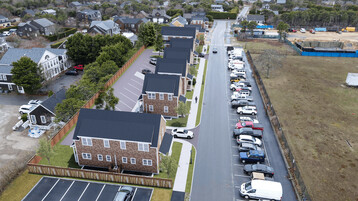
“When we’re talking about employee housing on Nantucket, it’s not a matter of yes or no, because it has to be yes,” Finance Committee member Peter Schaeffer said. “It’s a matter of when. That’s really the decision.”
While the cost per bedroom may initially appear to be higher than it was last year, that is largely because the project includes fixed costs related to design and other needed site work. Eventually, the site has the capacity for 24 bedrooms at around 15 million. Subtracting the site work, the cost is around $677,000 per bedroom.
“The bids came in, I think, very reasonable,” housing director Kristie Ferrantella said. “The longer we wait, the longer that we don't have the stable housing for our employees.”
The revised project is an example of the town taking the feedback received on the floor of Town Meeting and applying it by paring back the cost of the article and fleshing out a full plan for the site.
Like the Our Island Home facility, the employee housing development has divided town leaders. The Select Board voted unanimously to support it, but the Finance Committee’s vote in favor of the project was 5-4, and a lower-profile advisory committee tasked with reviewing capital projects recommended against it.
“The [Capital Program] Committee understands the critical impact that a lack of stable, affordable employee housing has on the ability of Town departments to deliver their necessary services to the people of Nantucket,” the advisory committee wrote in a report that opposed the project. “However, it is the opinion of CapCom that the private sector is better suited to develop housing given the materially negative cost implications of publicly developed real estate development. As such, CapCom strongly urges the Town to explore alternate methods of developing, constructing and operating the housing that it so desperately needs for employees across all departments.”
In defense of the project, town leaders have argued that housing remains one of the town’s top goals, and that it is needed to retain employees and ensure high-quality government services.
“The [Select] Board deems the creation of municipally owned housing to be a high priority,” the Select Board’s positive motion reads in part. “An adequate supply of housing for Town employees will increase overall government efficiency and reduce the costs associated with high levels of staff turnover.”
Ferrantella also pointed out that if the town doesn’t invest in employee housing, it will ultimately have to pay employees higher wages if it wants them to be able to afford to live on Nantucket. Either way, there will be costs.
“That's been the hardest thing is the retention,” Ferrantella said. “Not just the retention, but the recruitment.”
Ferrantella also said that the town is largely following in the footsteps of other employers on Nantucket, many of whom have opted to purchase employee housing in recent years as the cost of even one bedroom on the island soars beyond what many workers can afford.