Lawsuit Filings Reveal New Information On Status Of Vineyard Wind Project
JohnCarl McGrady •
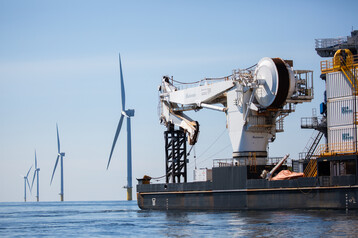
According to several Vineyard Wind executives, if the offshore wind farm isn’t allowed to resume construction, its unfinished turbines could pose a serious health and safety risk.
The turbines that pose the most risk are the so-called “hammerheads,” or turbines that are partially built but have not yet had blades attached. In multiple documents filed as part of its lawsuit seeking a temporary injunction against the federal government’s stop-work order, Vineyard Wind claims that if the company can’t attach the blades soon, they are at risk of catching fire, dumping debris into the ocean, or injuring Vineyard Wind employees.
For some Nantucket residents, this warning may carry uncomfortable echoes of the blade collapse that occurred at Vineyard Wind in August of 2024, sending tons of debris to Nantucket’s shores.
“The risks and impacts associated with hammerheads offshore are as follows: lightning strike, climate control in the Nacelle [head], and structural fatigue,” wind turbine team lead Steven Simkins wrote. “In the event of a [lightning] strike, there is a risk of the electrically powered and charged components in the hub igniting. Any electrical fire has the potential to propagate into the nacelle and cause a larger fire event.”
There are 10 hammerhead turbines currently installed at Vineyard Wind. Puneet Verma, a senior vice president for government affairs for Vineyard Wind’s parent company, Avangrid, claims that Vineyard Wind is the only project that currently has hammerhead turbines installed.
The Trump administration has downplayed the risks, replying that “[the Bureau of Safety and Environmental Enforcement] considered the issues raised by Vineyard Wind and determined that leaving the turbines in place without attaching the new blades did not pose risks for public health and safety.”
Vineyard Wind’s filings also provide an updated look at the status of the project. As of the stop-work order, 44 of the project's 62 turbines were fully installed, 10 were hammerheads, and 61 were at least partially installed.
After one turbine blade collapsed into the ocean south of Nantucket in August 2024, the federal government mandated that all of the blades manufactured at the same Canadian factory must be removed from Vineyard Wind turbines. But buried in Vineyard Wind’s filings is an admission that the last of these blades were not removed until after the recent freeze was put in place, almost a year and a half later.
“We have removed two Canadian blade sets and are ready to remove the last Canadian blade set, consistent with the safety provisions of our permit,” Vineyard Wind chief executive officer Klaus Skoust Møller wrote in an email to the Bureau of Safety and Environmental Enforcement on December 30th.

The Trump administration’s official position is that the wind farm isn’t likely to pose any threat to public safety. However, the Department of Defense does believe that continuing construction would be a danger to national security.
Citing those national security concerns, including radar interference, the Trump administration stopped all construction work on offshore wind last December. In the wake of the freeze, some critics have questioned the national security justification, alleging that the move was more related to Trump’s personal dislike of wind turbines, a claim that Vineyard Wind’s filings refer to multiple times.
Secretary of the Interior Doug Burgum claimed that the pause “addresses emerging national security risks, including the rapid evolution of the relevant adversary technologies, and the vulnerabilities created by large-scale offshore wind projects with proximity near our east coast population centers.”
As part of its argument against the need for an injunction, the federal government included a largely redacted testimony from acting deputy under secretary of war for acquisition and sustainment Dale Marks, which allegedly explains the previously unspecified concerns. The filing claims that the unredacted version of the testimony will be provided to the court in confidence.
In its filings, Vineyard Wind also argues that idling the turbines will put a strain on the energy grid, increase electricity costs for Massachusetts residents, threaten “extraordinary financial distress and likely the collapse of the project,” and set a precedent of bad governmental process. Verma cited concerns including fire, marine debris, an unsafe work environment, and the “structural integrity” of the turbines.
In its own filings, the federal government denies several of these claims, including those related to safety, and contends that any financial risk to Vineyard Wind cannot outweigh national security.
At least three offshore wind projects impacted by the federal government’s blanket freeze, including Equinor’s Empire Wind, Orsted’s Revolution Wind, and Dominion Energy’s Coastal Virginia Offshore Wind, have already received temporary injunctions allowing them to continue work. Vineyard Wind may be next.