Nantucket's Drought Downgraded To Level 1 "Mild" Status By State
Jason Graziadei •
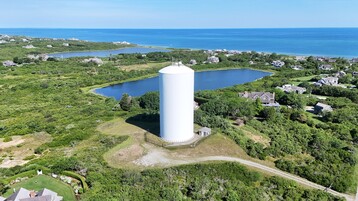
Nantucket's long-running drought has begun to subside.
The Massachusetts Drought Management Task Force on Monday announced that it had downgraded Nantucket's designation to a Level 1 "mild" drought. The island had been under a Level 2 "significant" drought status for more than a year.
"Finally," said Wannacomet Water Company director Mark Willett of the announcement. "Based on other well readings on the island we should be a level zero, no drought. But I guess we will take what we can get."
Willett had criticized the state's Drought Management Task Force in recent months for continuing to classify Nantucket as a Level 2 drought despite significant rainfall.
That designation prompted mandatory water use restrictions over the summer, including a ban on automatic irrigation, for all properties connected to the municipal water system. Users responded by significantly cutting back their water use by tens of millions of gallons over the summer.
The water in Nantucket's aquifer is technically owned by the state, so Willett is charged with managing the resource under a water withdrawal permit from the Massachusetts Department of Environmental Protection.
The state's Drought Management Task Force utilizes the United States Geological Survey (USGS) monitoring well 228 off Russell's Way on Nantucket to determine the island's drought status. That well has equipment that radios information about the groundwater table and elevation to the task force.
Willett has previously expressed concern about the well on Russell's Way, stating that it does not always accurately reflect the full picture of groundwater levels on Nantucket because of the soil type in which it was drilled. He has been actively lobbying the state to allow Nantucket to use multiple wells to determine the groundwater levels and the island's drought status.
In an Oct. 30th email newsletter from the Nantucket Land & Water Council, RJ Turcotte, who serves as the non-profit's "waterkeeper," shared a table showing the measurements of 10 wells from around the island between July and October 2026 that indicated groundwater had increased in four of them, but decreased in the other six.


"Among the wells in red is #228, the one utilized by the state to help determine Nantucket’s drought status," Turcotte wrote. "This location, near the intersection of Milestone Road and Russell’s Way, has seen a continuous drop since July. That’s not to say the recent rains haven’t helped - they certainly have! But rather than a recharge, at this point it appears to be more “slowing the fall” than making gains. The island averages a little over 40 annual inches of precipitation, mostly rain, in a given year. So far in 2026, we’ve seen 18.14 inches of rain since January 1 at the National Weather Service’s airport weather station."
According to the state's Drought Management Task Force, there are a number of actions resident and businesses in communities under a Level 1 "mild" drought status should take to conserve water resources, including:
- Minimize overall water use;
- Fix indoor leaks, such as from toilets, faucets, and showers, which result in more than 60 percent of indoor use;
- For larger buildings and businesses, conduct water audits to identify areas of leaks and potential water conservation opportunities;
- Consider installing a rain barrel to harvest rainwater for outdoor watering.
"During October, most of Massachusetts received approximately 2 inches of rain, roughly 2 to 3 inches below normal," the task force stated in its announcement on Monday. "Parts of Cape Cod, the Islands, and northwest Massachusetts received even less. Cape Cod remains in a Level 2 drought due to low groundwater levels. Groundwater typically takes longer to recover in this region because of its unique soil and geological conditions. The Drought Management Task Force (DMTF) will continue monitoring conditions over the coming weeks to determine whether the recent rain will lead to lasting improvements."