Two Years After Vineyard Wind Blade Failure, Government Investigation Still Not Completed
JohnCarl McGrady •

Two years after a Vineyard Wind turbine blade collapsed, littering Nantucket’s shores with debris, a federal investigation into the blade failure is still ongoing, with little indication of when it will be completed or why it has taken so long.
Almost immediately after the blade failure, the Bureau of Safety and Environmental Enforcement, a Department of the Interior agency tasked with safety and environmental protection for the offshore energy industry, announced that it would be launching an independent investigation into the collapse. Two years later, that investigation has yet to produce any results.
At this point, the investigation has actually outlived the agency that launched it. On July 10th, President Donald Trump announced that BSEE would be folded into the Marine Minerals Administration and would cease to exist as an independent agency.
In a statement shared with the Current, the Marine Minerals Administration confirmed that it was continuing the investigation, but offered few further details.
“The Marine Minerals Administration is ensuring the investigation is thorough and comprehensive,” the agency wrote. “MMA’s investigation is currently ongoing and does not have a date for completion at this time.”
This mirrors statements BSEE has given in the past.

BSEE’s investigation has taken significantly longer than other high-profile investigations into much larger offshore environmental disasters, including the Deepwater Horizon and Exxon Valdez oil spills.
One possible explanation could be funding cuts. BSEE and the Bureau of Ocean Energy Management, the two agencies merged to create the Marine Minerals Administration, have seen their staffing slashed by a third and are dealing with a significantly smaller budget, even as their joint responsibilities expand. Well before the merger, BSEE had already seen its budget cut by 35 percent, prompting criticism from environmental advocacy groups.
Several environmental groups and government watchdogs who have sounded the alarm on Trump’s funding cuts either declined to comment or did not return requests for comment for this story. The town of Nantucket also did not reply to a request for comment.
“It's hard to say who is to blame here, but it doesn't seem like the oversight agencies are enforcing anything, and it doesn't seem like Vineyard Wind is, once again, being a good neighbor,” Amy DiSibio, a representative of the anti-offshore wind advocacy group ACK For Whales, told the Current.
DiSibio also blamed Vineyard Wind for not providing sufficient reporting of its own on the collapse.
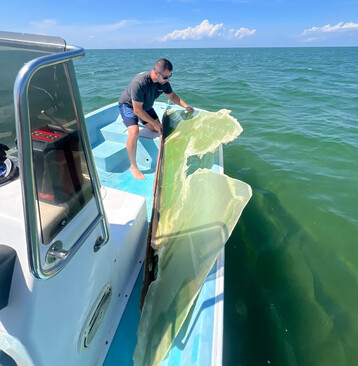
Another contributing factor could be how unique the case is. This is the first such investigation into an offshore wind blade failure.
GE Vernova has offered an explanation for the collapse, blaming it on a manufacturing defect related to insufficient adhesive bonding on a portion of the blade. Some reports have also claimed that employees at the plant responsible for the defect were instructed to falsify data. Ultimately, dozens of defective blades had to be removed from the wind farm.
Vineyard Wind is currently involved with a pair of lawsuits. In one, the company is being sued for over $1 million in rent in Boston.
It won a preliminary victory last month in the other lawsuit, seeking to block turbine manufacturer GE Renewables from exiting its contract with the wind farm after the GE Vernova subsidiary attempted to leave the project claiming Vineyard Wind owed it $300 million. Vineyard Wind had countered by claiming GE Renewables actually owed the offshore wind company $500 million stemming from the blade break. In that case, a judge found that GE Renewables was essential to the project’s success. At this point, despite completing construction, Vineyard Wind is producing much less power than it should generate under typical conditions, at least in part because of unresolved issues with GE Renewables’ turbines.