"Uncertainty And Fear" - Nantucket's Large Salvadoran Community Awaits President Trump's Decision On TPS Program
JohnCarl McGrady •

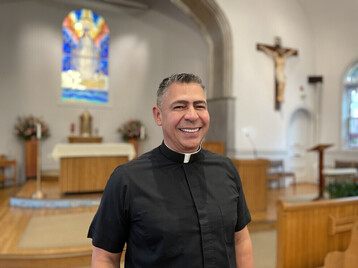
On September 9th, the federal protections that have allowed many people in Nantucket’s large Salvadoran community to remain on the island may be allowed to expire by President Donald Trump’s administration. Father Carlos Patiño Villa, who leads the Spanish-speaking congregation of St. Mary’s Catholic Church on Nantucket, isn’t sure what will happen then.
“Uncertainty and a fear that takes one's breath away are knocking at the door,” he wrote in a statement to the Current. “Questions arise at the dinner table amidst vacant stares—questions with no answers, leaving people to simply look upward, waiting for a miracle.”
For decades, many Salvadorans have lived and worked on Nantucket under Temporary Protected Status (TPS), a federal program that grants work authorization and protection from deportation to certain immigrants fleeing countries they cannot safely return to. On September 9th, President Donald Trump’s administration is expected to allow those protections to expire. Without them, some longtime Nantucket residents may be forced to return to countries they haven’t visited in years - even decades.
“I’ve been working on this island for so many years. I’ve been here for 30 years,” an island resident originally from El Salvador who has temporary protected status told the Current. “I haven’t been to El Salvador in over 40 years.”
The resident, who spoke on the condition of anonymity because of his immigration status, told the Current that he has a 15-year-old daughter. He wants her to grow up in this country, her home country, and attend school here. He wants her to go to college. Now, that dream is in jeopardy.
“Without these protections, I don’t know what we are going to do,” he said. “I don't know how to respond.”
Superintendent Elizabeth Hallett told the Current that the school will continue to treat all students the same.
“We are not permitted to ask, to know, to request information about immigration status,” she said. “We will educate any child that walks through the door, and that’s the way it is.”
But the school’s resolve may not be enough to protect these students. Patiño Villa said the news that TPS may expire soon has left some Salvadorans “adrift, directionless, and without hope.” One reason is the impact that the lapse in protections will have on local families.
“A young child, barely old enough for school, asks: ‘Do I have to leave, too?’ or ‘Who will I stay with?’” Patiño Villa wrote. “The mother silently wonders about her family's future. The father touches his forehead, thinking of the business he has formalized, the home he has purchased, and the dreams that still exist only on paper.”
TPS was created in 1990. Salvadorans were the first immigrants to receive protections under the law, which has since been extended to over a dozen other countries. While TPS is, as the name suggests, temporary, extensions can be granted if dangerous conditions persist in a country covered by the program. These extensions have often been routine for El Salvador in the past. The original TPS status offered in El Salvador expired in 1992, but it was renewed after an earthquake in 2001, and has since been renewed many times across both Republican and Democratic presidential administrations. Trump first attempted to end TPS for Salvadorans in 2018 but was unsuccessful.
The law that created TPS requires the federal government to conduct a periodic review of the conditions in a country covered by the protections to determine if they should remain in place. That review is supposed to be conducted at least 60 days before the expiration of TPS protections for a country covered under the law, but that has not yet happened for El Salvador.
Recently, President Trump ended TPS for several countries, including Haiti and Syria, and the United States Supreme Court upheld those actions in a 6-3 decision on June 25, 2026. The ruling means hundreds of thousands of immigrants may no longer be allowed to remain in the United States. El Salvador could be next.
“I was shocked when I heard TPS was going to get canceled,” the island resident from El Salvador said. “At this point, I am so sad I don’t know what to say.”
Cecilia Guttierez, a religious educator at St. Mary’s who also works in the island’s public school system, said that if TPS does lapse, it will upend the lives of many Nantucket residents.
“They would be losing their whole life, pretty much,” said Guttierez, whose family hails from El Salvador. “Because if they lose the TPS, they won't be able to work. They will be losing Social Security numbers and work authorization permits and possibly receiving deportation letters. They're pretty much going to end up undocumented completely, with a possible deportation letter.”
There are more than 170,000 people from El Salvador currently living in the United States under the TPS program. Gutierrez was unsure how many Salvadorans are on Nantucket with TPS, but she said that the last time TPS for Salvadorans was under threat of discontinuation in 2018, several island organizations held an event for island residents to meet with immigration attorneys at the VFW facility off New South Road. She said hundreds of people showed up for consultations.
“A lot of people showed up,” she said. “It was non-stop all day.”

On Nantucket, the Unitarian Church’s Immigration Resource Center works to connect immigrants with resources they may need. Reverend Erin Splaine, who serves the church, told the Current that the end of TPS could have serious consequences not only for the immigrants the program protects, but for the island in general.
“There is the moral wound, and there are the practical implications,” she said. “People that we know, friends and families of people that we know, kids in schools…might be gone. The community would be deeply impacted by that.”
Guttierez agreed.
“This would hurt a lot of families,” she said. “People who have loans and houses. They'll have to transfer all this to other people who are green card holders. From being legal to being undocumented and facing possible deportation.”
Splaine added that there could also be economic repercussions.
“That is a large sector of our complex workforce, and that would have practical and economic implications for everyone in this community,” she said.
Splaine said that immigrants in need of assistance should contact the Immigration Resource Center.
“We are all Nantucketers, and there are safe places to reach out to,” she said. “There are faces and places in this community that understand the diversity and complexity of this community.”