Veranda House On Trial: Jury Hears Opening Arguments In Lawsuits Over Devastating Fire
David Creed •

The legal disputes stemming from the devastating Veranda House fire in downtown Nantucket in 2022 have finally reached a trial.
Three neighbors of the Veranda House who filed lawsuits against the owner of the hotel and its staff who were employed when the massive fire struck the historic structure nearly four years ago presented their claims to a jury in Nantucket Superior Court this week. They are seeking millions in damages. The trial is expected to last well into May.
The lawsuits were filed by Kevin Davidson (4 Step Lane), Susan Renzulli (5A Step Lane), and Franklin Harris (5A Step Lane).
The neighbors are being represented by Jonathan Sweet of Keches Law Group. During his opening remarks, he went into great detail describing the damage to their homes. He displayed visuals on a video monitor of the home to show the jury the extent of the damage caused by the fire, including caved-in roofs and exposed rooms. He also detailed the physical, mental, and emotional toll the fire had on his clients - claiming that anxiety and severe depression were commonplace.
"Since the date of fire, these people began experiencing severe depression and anxiety," Sweet said. "Where are we going to live? How long will this take to rebuild? Can we rebuild? They aren’t young people."
Sweet told the members of the jury that they would be hearing from doctors who describe what Post-Traumatic Stress Disorder (PTSD) is, what causes it, and what it is like to live with it. He revealed that Harris fractured his heel the day of the fire by jumping off the porch in an effort to put the fire out, and that Kevin Davidson had just recovered from cancer and was in remission with strict orders from his doctors at Mass General Hospital to "eat, sleep, and avoid stress."
Sweet stated that there were now moments of normalcy in the neighbors' lives, but the stress remained.
“You will hear about glimpses of normalcy, and there were glimpses of normalcy. I’m sure (the defendant’s counsel) will talk about it,” Sweet said during his opening remarks. “They went on pre-planned trips, weddings, life went on. But under major stressors to these people’s physical and mental health.”
He concluded by stating the hotel, owned by the Rhode Island-based company The Procaccianti Group, is responsible for the damages, and claimed the company's representatives have said the right things in the aftermath of the fire - but now it is time for the jury to ensure that the neighbors are awarded damages.
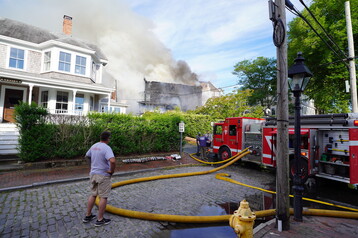
The defense team, led by attorney Dan Boho of Hinshaw & Culbertson LLP, filed documents in Nantucket Superior Court prior to the trial on April 27 stating that the hotel is accepting its legal responsibility for causing the fire, but is disputing the causation, as well as the nature, scope, extent, and duration of the neighbors' alleged damages. The company also states that significant reimbursements have already been made.
"The Davidsons and Ms. Renzulli sustained damage to their real property as a result of the fire," the filing reads. "The Davidsons own 4 Step Lane and were reimbursed the cost to rebuild the property. Susan Renzuli owns 5A Step Lane and was reimbursed for the net diminution of the fair market value damage to her condominium property. Also, the Plaintiffs were reimbursed for their loss of the contents and for other economic damages incurred for moving and storage and landscaping."
The Davidson's property took nearly two years to rebuild, while Renzulli's property is still under construction and expected to be completed in September.
One issue at hand is medical costs for multiple surgeries Renzulli underwent after falling through the floor of her home in the aftermath of the fire. She went through the floor "up to her midsection" according to Sweet on Thursday after public safety officials permitted homeowners to enter their homes to retrieve important belongings such as passports. Sweet said that had Renzulli known the floors were susceptible to collapsing, she would not have entered. The defense is arguing that some costs, such as these medical expenses, should not be covered by the hotel.
In an objection pertaining to causation, the defense suggests: "You must decide whether each plaintiff proved that the fire directly and proximately caused the particular damages that plaintiff seeks. There may be more than one cause of a claimed injury or loss. But the plaintiff still must prove that the fire was a direct and proximate cause of that specific item of damage. You may not award damages for harms that are remote, speculative, duplicative, or caused by later independent events, decisions, disputes, or conditions."
Boho used a portion of his time during his opening statement to speak to the jury about the neighbors all being out of their homes and away from the fire before they were in harm’s way. He acknowledged PTSD is a serious medical condition, but one that is the result of being exposed to actual or threatened death – which he argues isn’t the case in this situation.
“They all got alerted to a potential fire and were all out of the homes before a direct threat to them,” Boho said. "This was not actual or threatened death. They all were alerted to a potential fire and they all were out of the homes before there was any actual, direct threat to them."
The judge overseeing the trial is Daniel O'Shea. The trial is expected to end on Monday, May 11. There are 16 witnesses expected to testify with the plaintiffs expected to call 10 to the stand while the defense is expected to call six.
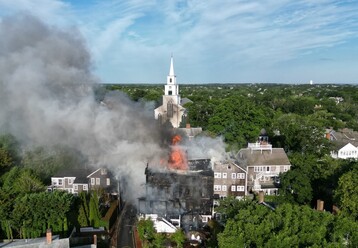
Davidson filed a $4.6 million lawsuit seeking $2.6 million for documented property damages to date and another $2 million for “emotional distress.”
Among numerous allegations in the lawsuit, the Davidsons accused The Procaccianti Group LLC (TPG) and 3 Step Lane LLC (3SL), the owners and operators of the hotel, of failing to install an automatic sprinkler system in that hotel that should have been required during a "complete renovation" in 2020. That created, according to the Davidsons, a “foreseeable fire hazard and casualty risk to the neighboring homes."
The Davidsons alleged that the ownership groups chose not to install automatic sprinklers in violation of state fire safety laws and regulations by “wrongfully and deceptively under-reporting the true cost and scope of the renovations to the Town of Nantucket thus allowing defendant to avoid the expense of installing a fire sprinkler system in the hotel as would have been otherwise mandated by state law.”
Renzulli filed her lawsuit against the owners of the Veranda House, the former general manager of the hotel, and two former employees she and her attorneys accused of negligence that resulted in the Veranda House being engulfed in flames, consequently destroying her home, and killing her pet cat Chloe.
“Plaintiff stood by in horror and watched as her home and its contents became engulfed in flames, desperately hoping that somehow her beloved 12-year-old pet, Chloe would escape the inferno," the suit says. “She did not.”
In Renzulli’s civil action sheet, her attorneys described her injuries as “severe emotional distress with objective manifestation of physical symptomatology and devastating uninsured financial and property losses due to defendants' collective negligence in causing a fire which spread to her residence.”
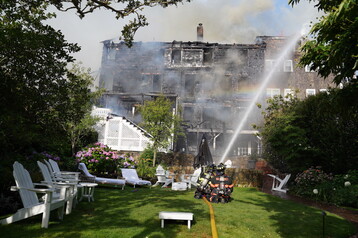
Neighbors allegedly complained about the smoking issue to Veranda House staff, but Renzulli and her attorneys accused the general manager and hotel caretaker of failing to develop, impose, and/or enforce appropriate smoking policies or restrictions related to the safe disposal of smoking materials on the hotel premises such as a designated smoking area with disposal equipment.
Harris accused the hotel owners and staff members of negligence in his lawsuit that led to the three-story, 18-room hotel being engulfed in flames after the root cause of the fire was determined to be an employee improperly disposing of a cigarette. The suit explains that Harris was home when the fire broke out and that it resulted in his home being destroyed and taking the life of his cat.
“As a direct and proximate result of the foregoing negligent acts and omissions of defendants, plaintiffs suffered significant uninsured financial and economic damages including but not limited to those related to the loss of his personal property, housing dislocation, lost wages and lost earning capacity, moving expenses, temporary housing costs, and others.” The suit alleged.
Harris also mentioned the lack of an automatic sprinkler system and carbon monoxide detectors having been recently disabled by the hotel.
“Prior to the date of the fire, there had been an ongoing problem with the improper disposal of smoking materials at the Veranda House as evidenced by cigarette butts littering the exterior grounds of the hotel premises,” the suit said. “Abutters had previously complained about the improper disposal of smoking materials to Veranda House staff. (The defendants) failed to develop, impose, and/or enforce appropriate smoking policies or restrictions related to the safe disposal of smoking materials on the hotel premises including but not limited to a designated smoking area with designated smoking material disposal equipment.”
In an interview with Jonathan Sweet of Keches Law Group, which represented each of the three neighbors above, Sweet told the Current in June of 2023 following the Davidson lawsuit in May of 2023 that it would be “the first of several.” The Renzulli and Harris lawsuits were subsequently filed in November of 2023 and August of 2024 respectively, and more suits remain unresolved.
“I can say confidently that this will be the first of several suits to come from people who were impacted by this fire,” Sweet said. “I think people have gotten to wit's end. The neighbors are up in arms right now because of all the heavy equipment they have brought.”