With Significant Tax Increases Looming, Is It Time To Raise The Residential Property Tax Exemption?
JohnCarl McGrady •

Should the Select Board lessen the property tax burden on year-round residents, even if it comes at the expense of higher taxes on summer residents?
Voters approved over $200 million in spending at Nantucket’s Annual Town Meeting and the local elections, a sum that could have a major impact on the tax bills of local homeowners. A year-round homeowner with a $2 million home could see their tax bill increase by $474.
But the Select Board can decrease that number if they choose to. The board can actually reduce the property tax impact on year-round residents somewhat significantly, but doing so would increase the tax burden on people who own seasonal homes on Nantucket, as well as year-round residents with highly valued properties.
The residential tax exemption allows towns to shift taxes from owner-occupied residential properties, primarily those with lower property values, to vacation homes, higher valued homes, and other residential properties not occupied primarily by the owner, including apartments and vacant land. It sets aside a portion of the value of all owner-occupied homes, exempting that portion from local property taxes. To ensure that the overall tax levy remains the same, the remaining value of homes without the exemption is then taxed at a higher rate.
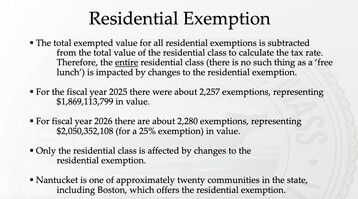
For years, Nantucket’s residential tax exemption has been set at 25 percent. The Select Board voted again to hold it steady last December, opting to keep the option to increase it in reserve in part to cushion the impact should voters endorse a large amount of spending.
“I believe that keeping some of this in reserve is important because of the expenses we face,” Select Board vice chair Matt Fee said at the time.
That has now happened.
“I do support raising it, especially in years where we have big projects like this,” Select Board candidate and Finance Committee chair Jill Vieth said at a recent forum hosted by the Nantucket Civic League. “Maybe in a bigger year, we need to raise it some. Maybe if we don’t have as many projects on the table, we could lower it a bit.”
At the hearing in December, several Select Board members suggested holding a meeting, potentially this spring, to discuss the possibility of increasing the exemption. After the election, Select Board chair Dawn Hill said that she would bring the topic up for discussion in the fall.
Select Board member Brooke Mohr suggested that the Select Board should consider raising the exemption to 30 percent.
“I think now is the time for us to think about going to 30 percent,” she said. “We do want support from the voters on capital projects, and I think that providing some relief to the year-round residents on their regular tax bill leaves a little bit of room for support on capital needs that we have that are growing.”
The maximum allowed residential exemption, now that Nantucket is designated as a seasonal community under the new state law, is 50 percent. The maximum exemption is based on the average residential value for the island, which is currently $3,597,109, meaning that a 25 percent exemption shaves $899,277 off a qualified property's value for property tax assessment purposes.
“We’re always kind of hedging our bets and keeping some dry powder,” Planning Board member Hillary Hedges Rayport said at Town Meeting. “For seasonal communities, our exemption can be pushed up to 50 percent, which gives us more dry powder, more ability to shift the burden away from year-round folks, and I think it gives us a little more breathing room, and it helps us do the right thing for our environment and pass articles like [the Somerset area sewer expansion].”
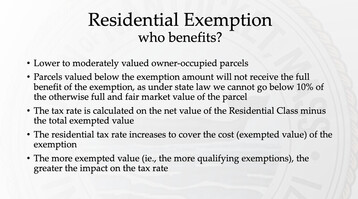
A 30 percent exemption would shave $1,079,132 off the average Nantucket home’s value. A 50 percent exemption would fully cut $1,798,555 from the valuation when property taxes are calculated. However, the residential tax exemption cannot reduce a property’s assessed value below 10 percent of its actual value.
Not everyone supports raising the exemption.
“Everybody wants to vote for this stuff, but nobody wants to pay for it,” perennial Select Board candidate Clifford Williams said. “I guess I would consider [increasing the exemption], but I really think that if people are going to vote for these projects, and they’re going to vote for more spending, then maybe they should feel the sting of it, and maybe they would be more conservative when they make votes and spend that kind of money.”
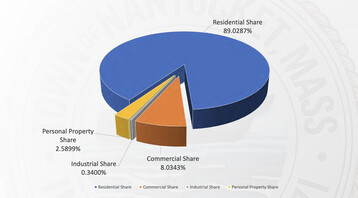
The residential tax exemption is sometimes misunderstood. It does not impact the tax rate for commercial property. The percentage of the tax levy paid for by residential property remains constant regardless of the exemption rate. Increasing the exemption only affects which residential properties are responsible for that levy.