Judge Denies Motion To Dismiss Charges Against Downtown Stabbing Suspect
David Creed •
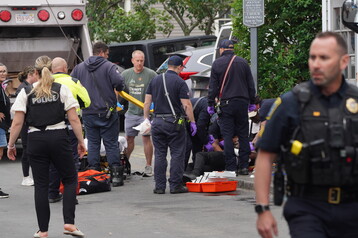
Kemar K. Downer, the individual charged with stabbing Andre Hamilton last week, had a motion to dismiss the case denied by Nantucket District Court Judge James Sullivan following a hearing on Tuesday morning.
Judge Sullivan allowed another motion to return Downer’s $2,500 cash bail and remove the GPS monitoring device that had previously been required by the court as a condition of his release. Sullivan maintained his previous order that Downer stay away and have no contact with Hamilton or his residence. Downer will return to court for a pretrial hearing on August 3rd, the same day as Hamilton’s arraignment for charges related to the same incident.
Tuesday's hearing was fairly brief and touched on the motion filed by Downer's attorney, Rob Moriarty, which was based on Moriarty's claim that Nantucket Police failed to bring Downer in for an arraignment promptly following his arrest, and held him in custody overnight.
Moriarty was citing Jenkins v. Chief Justice of the District Court Department, a 1993 Massachusetts Supreme Judicial Court case, as well as Article 14 of the Massachusetts Declaration of Rights, which calls for prompt judicial determination of probable cause. During last week's arraignment, which was held the morning after Downer's arrest, Moriarty voiced his displeasure with law enforcement over his client being held overnight and not being arraigned the day of the stabbing.
"This incident occurred at approximately 10:30 a.m. and he was done giving statements to the Nantucket Police by around 1 o'clock and then they didn't bring him to court as they're required to under the law while court was sitting, while there was defense counsel there waiting for an arraignment, while the Commonwealth was ready," Moriarty said. "He's charged with stabbing. They should have brought him to court (Tuesday) afternoon. His right to a prompt arraignment was denied, and the complaint under Jenkins should be dismissed.”
The prosecution requested the motion be denied during Tuesday morning's session on the grounds that Downer was still brought into court within 24 hours of the arrest despite the Nantucket Police conducting multiple investigations that led to charges against Downer and Hamilton. The prosecutors did not explain during the hearing why it took nearly one week longer for charges to be officially filed against Hamilton in Nantucket District Court.
Assistant district attorney Aine Dillon also pointed to note 11 in the Jenkins case, which states that criminal arraignments on Martha’s Vineyard and Nantucket can take more than four days following an arrest, given that the islands do not have daily court sessions.
In response, Moriarty pointed out that Nantucket District Court was in session the day of the stabbing, and that by two or three o’clock in the afternoon, the investigation had been completed with more than enough time to bring him down to the courthouse for an arraignment, as all necessary court personnel were present. He also said the Jenkins case was a decision “made in 1993” when it wasn’t as easy to get people and resources together quickly (either in-person or through Zoom).
Sullivan and Moriarty engaged in conversation over the Jenkins case referring strictly to weekend arrests. While Moriarty pointed out that Downer’s arrest was a Tuesday, Sullivan said the Supreme Judicial Court noted it could take several days regardless of what day the incident took place.
Sullivan acknowledged the court was in session Tuesday and the practice of Nantucket District Court is to hold arraignments as soon as possible.
"It's pretty clear to me that he's done being booked by three o'clock," Moriarty argued in response. "He could have been brought (to the court) and he was not. And the presumption is that you're supposed to take a person to court if they are in session, and (the police) didn't. They deprived him of his liberties to his detriment.”
Sullivan concluded by saying he understands Moriarty’s frustration, but this was not a straightforward case, and ultimately he decided not to dismiss the case since everything was still done within the 24-hour period.
"There were multiple witnesses to be spoken to and both parties involved in the altercation ultimately ended up being charged, so this wasn't a straightforward investigation," Sullivan said in his decision. "I understand your frustration because, like you, Mr. Moriarty, we were waiting for the arraignment pretty much the whole day. But we don't have control over what goes on over or outside of the courtroom. I think, based on my calculations, we are within the 24-hour period. I have read some cases that suggest that even in the event of a Jenkins violation, dismissal would be the inappropriate remedy. But I will note your objection to all those things, and I think it's a good point to take when we try to move these things and should move these things as quickly as possible, particularly when we have custodies involved.”
Moriarty then asked Sullivan to reconsider the $2,500 cash bail and GPS monitoring device, given the circumstantial changes with the case following charges being pressed on Hamilton. Moriarty continued to reference a surveillance video, noting that it shows clear self-defense on the part of his client. He said the GPS system was a “serious restraint on his liberty."
The video, obtained by the Current last week, appears to support Moriarty's claim of self-defense, as it shows Downer being approached and attacked first by Hamilton:
"This case is ultimately, under the circumstances, going nowhere," Moriarty said bluntly. "He has every reason to come to court, and there's no reason for the GPS. Your initial decision was very fair, but he acted totally in self-defense. I'd ask that you reconsider."
Dillon responded by saying, “The commonwealth does not know where this case is going and neither does counsel.”
Dillon requested the bail remain in place but did not argue against the removal of the GPS device – asking only for Downer to stay away and have no contact with Hamilton and to stay away from his residence.