New Private Club Proposed For Old South Road Gets First Look From Planning Board
JohnCarl McGrady •
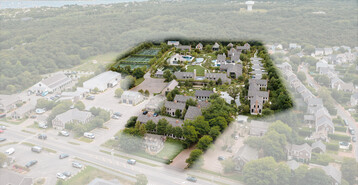
A preliminary Planning Board review of developer Alan Worden’s proposed private membership Hensdale Club on Monday became a reflection on what Nantucket should look like in the future, with neighbors, Planning Board members, and other islanders debating a broad set of topics, from Nantucket’s diminishing commercial land to the nature of the traffic that routinely backs up Old South Road.
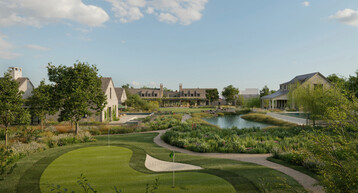
The proposed club, slated for the Valero family’s property off Old South Road, would feature an equestrian program, regenerative agriculture, a greenhouse and gardens, swimming, and racquet sports.
A significant portion of Monday’s discussion was spent on the potential alternative uses of the land. The Valero property is a rare example of a large, mostly undeveloped swath of land on Nantucket that is zoned as “commercial neighborhood” or CN, meaning it could be developed for business or residential use. The Hensdale Club, by contrast, is a low-intensity use. That is appealing to some neighbors.
“We view it as the best possible outcome for that piece of property,” said Scott Wilson, the chair of board of trustees for the nearby Naushop neighborhood.
Some Planning Board members echoed Wilson’s sentiments.
“The land is beautiful, and everything looks gorgeous,” Planning Board member Liza Hatton said. “It's probably less intense than it could be.”
But real estate broker and affordable housing advocate Brian Sullivan worried that the erosion of available commercial land on Nantucket has driven up the cost of doing business and left new would-be business owners with few options.
“The loss of commercial land on Nantucket has been drastic,” Sullivan said. “It effectively has 3xed the cost of commercial property around the island, and it's limited the opportunities for small businesses in a lot of locations, and I can guarantee that we are never going to create more commercial out of residential here on the island, so to think about the net benefit to the island, it is an overall reduction to our economy to remove commercial opportunities from small businesses.”
In many ways, Monday’s discussion at the Planning Board was about more than just the Hensdale Club. It was about competing visions of Nantucket, and what the island may stand to lose - or gain - as an old way of life gives way to the increasing pressure of the tourist economy amid an unrelenting housing crisis. The connection between private clubs and affordable housing developments isn’t always obvious, but the location of the proposed Hensdale Club, which would sit across the street from the largest affordable housing project in the island’s history, makes it easier to see.
“Right across the street, we lost Glowackiland,” charter boat captain and Planning Board member Brian Borgeson said, referring to the ramshackle collection of housing, businesses, and partially illicit waste disposal sites that predated the Richmond affordable housing development beside the proposed Hensdale Club. “That's where the grease monkeys, and the boat captains, and the guys fixing stuff, that's where we all used to go, and now we're getting another club, where not one tire is going to get changed, or one oil change is going to happen.”
Of course, it was also possible that the Valero’s property could have become another Richmond, or at least a major housing development in its own right. The Hensdale Club also forecloses that possibility, for better or for worse.
“For me, the community benefit is not having 10 acres of what CN could be, which is multi-family housing, liquor stores, I mean, the use chart on CN is a laundry list,” Planning Board chair Dave Iverson said.
Iverson may see it as a community benefit to avoid a dense housing development in the area, and the residents of Naushop - who live in a relatively dense housing development themselves - may agree. But as the island continues to struggle with one of the country’s most intense housing crises and the Select Board begins to retreat from taxpayer spending on affordable housing projects, some have floated the possibility that dense, privately-funded residential development might be necessary for Nantucket.
Predictably, given the club’s location on Old South Road, traffic was another chief concern for Planning Board members and town staff.
“There is a circulation concern along this corridor,” town of Nantucket transportation program manager Mike Burns said. “One, for operations, and the other for safety.”
A traffic study commissioned by the Hensdale Club’s developers suggested that the club will increase traffic in the area by 10 percent at most. But with how busy the area already is, a 10 percent traffic increase could be significant.

“A 10 percent increase on a completely full road is like a 10,000 percent increase,” Borgeson said. “This is a lot, a lot, a lot to develop on a road that, to me, is already almost at its breaking point. I know a lot of people that live in [the nearby Naushop neighborhood]; a lot of them complain to me about the traffic every single day, and that's during school, that's during the summer, that's all times, so this is a massive undertaking to fit right across from Richmond.”
Burns suggested bringing in a consultant to review the development’s traffic impacts. The conversation then turned to the so-called “Milestone connector,” a potential small connecting road between Milestone Road and Old South Road that the town has long wanted to build to alleviate traffic on Old South Road. Building that road could make the Hensdale Club more palatable for some town officials and area residents, but it ultimately isn’t in the developers’ control.
One Planning Board member, however, suggested a lower level of concern about the club’s possible traffic impact.
"We're just moving the cars around," Planning Board member Nat Lowell said. “The cars are already on Nantucket.”
Lowell did add, however, that traffic was still his concern, especially at the busiest times of the day. It was a concern shared by many members of the Planning Board.
The developers were also asked about their efforts to benefit the Nantucket community beyond the club’s membership. Planning Board alternate Dylan Metsch-Ampel suggested offering affordable offseason memberships to islanders. Worden and his team outlined potential benefits including housing units for island teachers, food donations, fellowships for island non-profit leaders, and charitable donations.
“There are a variety of community benefits,” Worden said. “I think if we can activate some of these spaces in the winter, which seems obvious to us, we want to do it.”
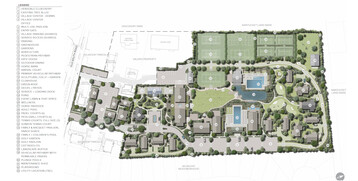
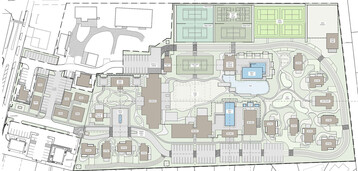
The plans for the club also include six housing units with 148 beds for club employees. The club is planning for around 150 employees and 580 members. There will be 175 parking spaces on site.
Planned amenities for the club’s 580 members include a clubhouse with dining, function rooms, a co-working space and ten guest rooms; a greenhouse; a general store; a bike shop; a kid’s club; a wellness center; a barn with a paddock and horses; club cottages; adult and family pools; courts for racquet sports including tennis, pickleball, and padel; and a golf performance center.