No Commitment From Select Board To Bring Geotube Expansion Project Back To Town Meeting
JohnCarl McGrady •
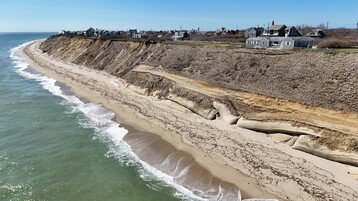
The Select Board on Wednesday declined to formally commit to supporting a second Town Meeting warrant article asking to expand the controversial geotube erosion control project along the Sconset Bluff this spring. But some members suggested that if the Sconset Beach Preservation Fund (SBPF) commits to supplying necessary mitigation sand and repairing damage to the existing geotubes, the path toward inclusion on the Town Meeting warrant looks favorable.
“I don’t think we can commit to putting it on the warrant,” chair Dawn Hill said. “For myself as a board member, if this moves forward and there’s sand maintenance done to the project and all of this moves in a good direction with the Conservation Commission, then I would support putting it on the warrant.”
SBPF has asked for assurance from the town that it will support an article for the 2027 Annual Town Meeting warrant seeking voter approval for the expansion, but until now, no town officials have publicly addressed the possibility.
SBPF is currently navigating the Conservation Commission approval process as it attempts to repair damage to a portion of the existing geotube installation, which the organization claims was caused by vandalism. It seems likely the Conservation Commission will soon grant that approval, but in some statements, SBPF representatives have appeared wary of investing too much into repairs without guarantees of town support for future warrant articles related to the expansion.
“We remain concerned that SBPF is being asked to undertake significant repair and nourishment expenditures without a clear indication from the Town regarding its intended path forward on those two issues. The cost of repairing and restoring the existing system is substantial, and SBPF must make decisions regarding those expenditures before Town Meeting can consider any future expansion proposal,” SBPF representative Meridith Moldenhauer wrote in a letter to the Select Board. “We understand the Town's position that sand nourishment will be important to the prospects for voter approval of a future warrant article. SBPF likewise believes that restoring and improving the condition of the existing project is important. However, we would welcome an opportunity for the Select Board to publicly discuss the future of the project.”
Select Board vice chair Brooke Mohr criticized SBPF for this approach.
“Maintenance of the existing project has to move forward, and suggesting that your willingness to do that is contingent on our commitment to putting this back on the warrant, or the implication that there’s contingency there, or need for that, concerns me greatly,” Mohr said. “I appreciate all the efforts you’re making, but I’m waiting to see action.”
For decades, SBPF has battled local activist groups and regulatory bodies over the geotubes, which are long textile fabric rolls filled with a slurry of sand and water and installed at the base of the bluff to protect the homes perched along Baxter Road above.
Opponents have raised concerns about the impacts of the geotubes on nearby beaches and about the source of the mitigation sand that SBPF is required to pour over the tubes to ensure those beaches are not eroded—a requirement SBPF has often shirked.
Proponents have argued that the geotubes and the potential expansion, which would come at no cost to Nantucket’s taxpayers, are needed to protect Baxter Road and avoid the potentially enormous expense of providing utilities to homes along the bluff should the road be deemed impassable.
The expansion proposal was narrowly defeated at the 2026 Annual Town Meeting, but the town has had some recent success bringing back articles after an initial defeat.
In her letter to the Select Board, Moldenhauer suggested that if the expansion does not move forward, SBPF might ask the town to pay for a portion of the repairs.
“Given the significant public benefits associated with the proposed repair work, including the protection of Baxter Road and related Town infrastructure, we would welcome the opportunity to discuss whether a contingent cost-sharing or reimbursement framework could be established should SBPF proceed with the requested repairs and nourishment efforts, but the proposed 2027 warrant article ultimately is not moved forward,” Moldenhauer wrote. “If the long-term project receives Town Meeting approval, SBPF would expect to absorb the repair costs as part of its ongoing commitment to the project.”
After a judge sided with SBPF and rejected a lawsuit challenging the legality of the expansion in July, support from Town Meeting voters is one of the two significant obstacles still remaining for the project. The other is state approval: the Massachusetts Department of Environmental Protection has yet to rule on the expansion and appeared critical in one letter, though Moldenaheur argued the letter was simply a request for further information from SBPF.