State Is Critical Of SBPF In Latest Salvo Over Geotube Expansion Project
JohnCarl McGrady •
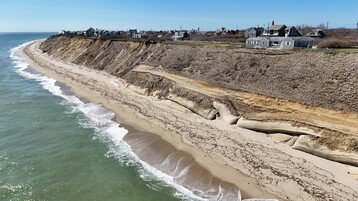
In a letter released this week, the Massachusetts Department of Environmental Protection has criticized the Sconset Beach Preservation Fund (SBPF) for allegedly failing to provide information in response to previous DEP inquiries as the state weighs whether to allow the expansion of SBPF’s controversial erosion control geotube installation along the Sconset Bluff.
“There remain a number of issues where additional information is required or where you did not provide a sufficient response to our inquiries,” the DEP wrote in a letter obtained by the Current. “A sufficient record and meeting applicable regulatory standards is necessary to allow the Department to issue [a superseding order of conditions] that meets regulatory requirements and can sustain an appeal.”
SBPF representative Meridith Moldenhauer told the Current that she doesn’t see the DEP letter as a criticism, instead characterizing it as a straightforward request for more information that SBPF has already provided to other regulatory bodies and can easily pull from existing records.
“This is, in our view, the normal process. We see the letter as DEP asking for routine procedural documents that they need,” she said. “Even though we have provided these documents previously to [the Massachusetts Environmental Policy Act office] and the ConCom, they are asking us to provide additional documents. The record is obviously there.”
The DEP letter is not a rejection of SBPF’s proposal to expand the geotube installation from 900 feet to nearly 5,000 feet, but some project opponents see it as an obstacle for the expansion.
“We are gratified that state officials are focusing on the facts, the science, and the law,” said Burton Balkind, the president of the Nantucket Coastal Conservancy, a group that has long opposed the geotubes. “Just as our local [Conservation Commission] should have been during their public hearing on the matter. Many of MassDEP’s questions are similar to those asked by members of the public during the [Conservation Commission]’s deliberations. It’s good to see the state insisting that these legal and environmental questions be answered fully and objectively.”
The expansion has received mixed feedback from key decision-makers this year. On one hand, the Massachusetts Superior Court recently rejected a legal challenge to the project, and the expansion also cleared Massachusetts Environmental Policy Act review.
On the other hand, the state’s Office of Coastal Zone Management appears skeptical of the project, and local voters rejected it at Town Meeting last spring. Even if the DEP does ultimately allow the expansion to go ahead, approval will still be needed at a future Town Meeting.
The geotubes, which are long textile fabric rolls filled with a slurry of sand and water and installed at the base of the bluff to protect the homes perched along Baxter Road above, have courted controversy even before their installation in 2014.
One of the issues raised by the DEP is likely to be familiar to both SBPF’s supporters and critics. A known problem with geotubes as a method of erosion control is that they can accelerate erosion along adjacent beaches by redirecting wave action and failing to provide sand for waves to deposit when they hit the shore at either end of the erosion control project. To prevent this, geotubes are often approved under the condition that large amounts of sacrificial sand are poured on top of the structure. The waves can then take this sand and carry it with them, preventing what is often referred to as “end scour.” A requirement of this kind was imposed on the existing array, but SBPF has often ignored it.
“Some of the aerial images that plans are overlaid upon show end scour associated with the pilot project,” the DEP wrote. “The pilot project, which is a similar design to the proposed expanded project, appears to have end scour as a consequence. The Applicant needs to explain or demonstrate how or why the proposed project will not result in similar scour; or revise the proposed project to address the potential for end scour.”
Moldenhauer said that SBPF already addressed this point in filings submitted to the Conservation Commission and the Massachusetts Environmental Policy Act office, and is happy to do so again.
“We specifically redesigned the project to address this and to provide better returns on this issue,” she said. “It is in that record.”
Opponents have long raised concerns about scour and the source of any mitigation sand that SBPF would use, while supporters have countered that the geotubes and the potential expansion, which would come at no cost to Nantucket’s taxpayers, are needed to protect Baxter Road and avoid the potentially enormous expense of providing utilities to homes along the bluff should the road be deemed impassable.
Another key issue is the location of the geotubes. The DEP says that SBPF’s plans show proposed geotubes on coastal dunes, which would be a violation of state law. Moldenhauer declined to explain the reason for this concern, saying only that “we will be responding to that point.”
The DEP also claims that SBPF’s reliance on previous Conservation Commission rulings is “essentially irrelevant” and repeatedly calls the existing plans for the expansion unclear and inconsistent. Allegedly, SBPF’s plans do not note the location of critical resource areas, are not stamped or certified by an engineer or other professional, and fail to meet the standards previously outlined by the DEP, among other issues.
Moldenhauer said that this information is included in the record submitted to the Conservation Commission.
“I view this as, you present a lot of evidence and then somebody wants a closing argument,” she said.
Additionally, the DEP says that SBPF has not supplied a study showing how sand in the area is transported or conducted an analysis of potential alternatives to the geotubes that satisfies minimum regulatory requirements.
“The Department notes that it appears that there are properties to the North of the proposed project on the same side of the island that have achieved effective protection with coir terraces and nourishment,” the letter continues. “That may be an appropriate alternative to analyze for the proposed project site or even discrete areas of the proposed project site given its long linear footprint.”
In contrast, the DEP said that the neighbors and local stakeholders who have appealed the Conservation Commission’s order allowing the expansion “are organized, represented by counsel, and have submitted comments and data in support of their position. The Appellants have also submitted comments in response to [SBPF’s request for information] response documents, including detailed calculations based on their review of the additional information.”
The DEP’s letter comes after the Conservation Commission expressed willingness to allow SBPF to repair a portion of the existing structure that was damaged in what SBPF has called an act of vandalism.