Artificial Turf Field Approved At Nantucket High School As Part Of $26M Athletic Facilities Project
JohnCarl McGrady •
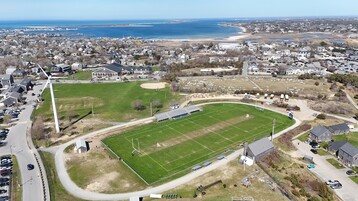
Town Meeting voted 719-281 on Monday to support the Nantucket Public Schools’ (NPS) plan to renovate the athletic facilities at Vito Capizzo Stadium, a proposal that includes an artificial turf field and a synthetic track. The vote was an emphatic win in the school system’s years-long quest to upgrade the aging infrastructure behind the high school.
"The need to upgrade our stadium has only become more urgent due to increased student enrollment and participation in athletics," Superintendent Elizabeth Hallett said. "This is not just about athletics. It is about providing safe conditions and ensuring equitable access for all members of our island community."
Overcoming opposition from voters concerned about the potential harmful effects of an artificial turf field slated for installation in place of the current football field, the $26 million project cleared what may be the toughest obstacle in its path Monday night, but several hurdles remain before NPS can break ground.
The project, included on the Town Meeting warrant as Article 12, still needs the support of a simple majority of voters at the ballot box on May 19th, and there remains a chance that the Board of Health could intervene to stop the use of artificial turf.
The Board of Health’s next regularly scheduled meeting is May 21st, and it is likely the issue will be on the agenda again. The Board has considered several responses to artificial turf, including an island-wide ban and stringent testing requirements, and it is unclear what restrictions, if any, it may impose.
The Board’s dynamic may also soon change sharply, as several members will see their terms expire in June and may struggle to find the Select Board support needed for reappointment amid heavy criticism from the Select Board surrounding the Board of Health’s handling of the turf discussion.
But the Town Meeting vote is a major step forward for the project, which has been at the center of one of Nantucket’s most hotly contested debates for the last seven months and has been under consideration by NPS for years.
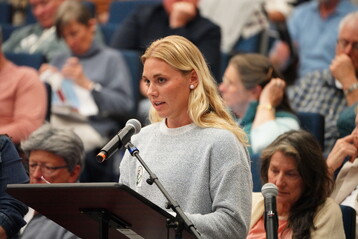
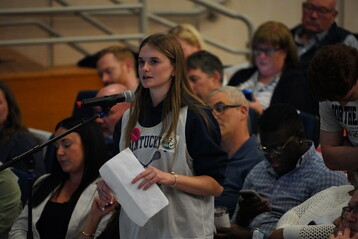
"Article 12 is about addressing a real and immediate need in this community," two-sport captain and high school student Alex Wisentaner said. "It's about protecting athletes, it's about supporting youth programs, and it's about making sure Nantucket provides safe, reliable spaces for everyone who uses the fields."
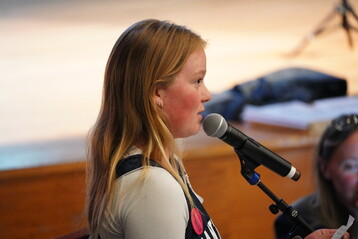
Article 12 drew more comments from Nantucket's younger residents than is usually seen on Town Meeting floor. Other students who spoke include lacrosse player Grace Hanlon, three-sport athlete and leading turf field advocate Madden Myers, and football player Eli MacIver.
From the beginning, the debate surrounding the use of artificial turf has overshadowed the rest of the project. Concerned Nantucket residents, including leading anti-PFAS activists and the Nantucket Land and Water Council—an environmentalist non-profit that often takes positions on political issues—have opposed the project on the grounds that it would spread toxic substances such as microplastics and the so-called forever chemicals known as PFAS into the nearby environment and potentially contaminate Nantucket’s sole-source aquifer.
"PFAS is a real danger. PFAS leaches out of the turf. Plastic particles—nano-particles, micro-particles—leach out of the turf. The turf is a problem," said Dr. Tim Lepore, the one School Committee member who voted against the proposal. "The turf field, to me, is a loser. We have the highest incidence in Massachusetts of breast cancer. We have a number of our firefighters that have had cancers. We have to avoid the PFAS."
NPS maintains that the turf they are planning to use contains no intentionally added PFAS, and has committed to testing it. With the details of a testing regimen still under discussion between NPS and the Nantucket Land Water Council, some worry that those claims are misleading and the proposed tests can’t account for all PFAS.
"There are no safe levels of PFAS, whether it is detectable or not," former firefighter Robert Bates said. "If, or when, there is a problem with the wells located around the school on private property, is there a fund being established to install municipal water for those households, or do they just have to suck it up?"
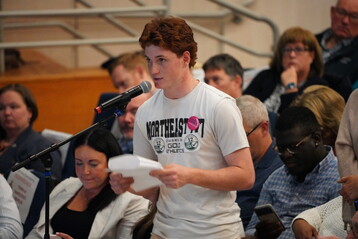
During the debate Monday night, island resident Meghan Perry proposed an amendment to strike the turf field from the proposed renovations. Her amendment failed on a 404-636 vote.
"There are issues with grass as well," emergency room nurse and parent Kate Garrette said. "2,000 pounds of fertilizer is placed on Capizzo field every year. 500 a season. There is peer-reviewed evidence and research that shows that leaches into our groundwater."
But when the school briefly entertained the idea of using natural grass instead, the pushback was even more intense. School Committee meetings were flooded with parents, coaches, and students arguing that turf was a necessity, as it can sustain far more hours of practice and play without degrading.
It is grass, they claim, that poses the real threat to health and safety: given the number of hours NPS logs on its fields, even a highly skilled grounds crew can’t prevent the field from deteriorating, which leaves athletes vulnerable to injury. These arguments were reiterated during Town Meeting.
"As a current lacrosse player, I've seen firsthand how the poor field conditions are affecting athletes," Hanlon said. "I've personally experienced falling on this field and walking away with cuts and scrapes from the rocks embedded in the ground. What's even more frustrating is I've played on turf fields this season and fallen in similar ways, but didn't experience the same injuries. That contrast makes it clear: our current field is part of the problem."
A synthetic track that would encircle the field has drawn some controversy of its own, and the Board of Health has floated the possibility of banning synthetic tracks as well.
The project also includes bathrooms, improved ADA compliance, a new booster and concessions building, lighting that complies with dark sky regulations, and new bleachers, all of which have gone almost undiscussed.
The debate over the turf field will have a lasting impact on Nantucket’s political landscape. Since the Board of Health took up the issue and began to discuss the possibility of an island-wide ban on artificial turf, the Board, which often remains relatively low-profile, has drawn large crowds and pitched debate to its previously quiet meetings.
Board of Health chair Ann Smith and vice chair Meredith Lepore have both been the subject of controversy stemming from their involvement in the debate, Smith for a series of emails and public statements that appear to have misled the public about the nature of the Board’s deliberations and skirted close to violating the state’s opening meeting law, and Lepore for a motion she ultimately did not make that would have instituted a moratorium on turf and synthetic track across the island.
Following one Board of Health meeting, before which Smith sent her fellow board members a pair of motions she intended to make related to artificial turf, open meeting law complaints were lodged against Smith. Three members of the Select Board, a quorum of that board, intervened to stop her without a properly noticed meeting of their own, triggering another open meeting law complaint that is now being reviewed by the state’s attorney general.
Smith and Lepore will both see their terms expire next month. If they are not reappointed by the Select Board, Article 12 may be the main reason why.